Brussels Study Trip: Blog 1

I’ve written before about the role teachers play in transatlantic relations (see, for example, this post and this one), and I teach about the EU in my classes, but this year I wanted to take it a step further- I decided to take my students to Brussels. For one week (July 8-15), I’ll be taking eight students on a study trip to learn about the EU and transatlantic relations.  During that time, we’ll be visiting the following places:

  • The EU Council (thanks to Alexandra Ekkelenkamp and Dominique Bryan for helping to coordinate this visit)
  • The Permanent Representation of Sweden to the EU (thanks to Anna-Charlotta Erikson for helping to coordinate this visit)
  • The European External Action Service (thanks to Nicole Meijer for helping to coordinate this visit)
  • The European Parliament (thanks to Kirsten Jongberg for helping to coordinate this visit)
  • The European Committee of the Regions (thanks to Katie Owens and Francoise Dumont for helping to coordinate this visit)
  • Sweden’s Social Democrats in the European Parliament (thanks to Helena Strandberg-Luthi and Elisabeth Gehrke for helping to coordinate this visit, and thanks to MEP Jytte Guteland for agreeing to meet with us)
  • Deutsche Welle (thanks to Steffi Rosenbusch and Maximilian Hofmann for helping to coordinate this visit)
  • US Mission to the EU (unfortunately, they had to cancel our visit due to last-minute obligations)
  • #EUTweetUp (thanks to Jon Worth and Katie Owens for helping to coordinate this)
  • The House of European History
  • Bruges

To help them prepare, we met once a month, read a number of articles/papers, and visited the websites of each of the places.  I also created a Twitter list of the places we’ll be visiting and some of the people we’ll be meeting.

During our time there, my students and I will be sharing our experiences via social media and this blog.  To begin with, I had them write a paragraph about what they hoped to gain out of the trip.  Here are six of the responses:

Katie B.
I am so excited that my first time traveling to another country is to Brussels for this EU study trip! This trip is so full of wonderful opportunities and I’m so grateful I am able to participate. One thing I am especially looking forward to is our meeting with Sweden’s representative to the EU. I admire Sweden’s feminist approach to foreign policy, it is so comprehensive and well thought out and their execution is incredibly effective. I really think it is one of the main reasons they are such a successful, democratic, and advanced nation, so I hope to ask a lot of questions and gain a lot of information from that meeting. I am also really excited for our day trip to Bruges! The history behind art and architecture fascinates me, so Bruges, with its rich history and and gorgeous architecture, has been a dream destination of mine. There are so many wonderful things planned for the trip, and I can’t wait to go and experience it all next month!

Andy K.
In my entire life I have never been more excited about a trip and the prospects that it holds. As someone who is deeply passionate about politics, I relish at this amazing opportunity that this trip will give me to explore international relations.  I may not always agree on everything that the European Union does, however I must grasp a deeper knowledge on how it functions productively while balancing the wants of sovereign nations. Within this, I am specifically curious on economic policy and trade. For instance how does the EU ensure that trade agreements are beneficial to all member states with each individual state having diversified economies? Questions like this fascinate me and I hope I can get answers about them. On a different note I am looking forward to immersing myself in the culture of Brussels. For many years I have wanted to go to Europe and finally this trip gives me the chance to personally experience it. In conclusion I can’t wait for the knowledge that this trip will equip me with and the lifelong memories that I will make.

Julia P.
I’m super excited to not only see the past- the beautiful buildings and streets of the city- but also the future. I look forward to meeting with representatives from Sweden and the US missions to the EU and NATO to talk with them about what is happening now and their plans to change the world. I’d love to ask them how the Trump presidency has changed their personal experiences and/or altered their jobs. As this is a field I am considering for a career, I’d also like to ask them what their job entails on a day to day basis. Additionally, I hope to gain a broader, more internationally based knowledge on US issues. Living in the US can make a sheltered view on these topics, and I’m very interested to see how the international community views things such as border control, refugees, and healthcare. Lastly, I hope to also get to know the city of Brussels itself, and really experience the culture and pulse of this beautiful city. I’m looking forward to the trip!!

Bailey A.
You are not often given the chance to widen your worldview when living in a small town, inside a liberal bubble, in a state people in the rest of the country can’t even point out on a map. These exact reasons are why I jumped at the chance to visit a place with a nearly continental government, an institution the likes of which have never been seen before. Traveling abroad is a wonderful opportunity and learning experience, especially when combined with in-depth learning about world politics in the current political climate. It deeply interests me to learn about how everything is juggled between institutions, getting regional support, working on better trade, cooperating with volatile neighbor countries, countries making unpopular decisions, and foreign policy, while still managing to agree and be a leading world power. These are ambitious goals that are completely achievable with a strong system like this, and I can’t wait to see how they all fit together. I am also looking forward to speaking with Sweden’s Representative to the EU. Next year one of the three countries our Model UN team is representing is Sweden, and I can’t think of any better way to learn about Sweden than from one of the people who knows it best. I am really looking forward to meeting some of the people who make this whole operation work, while visiting such an amazing and historic country.

Catalina G.
I am really looking forward to this trip.  It will be really interesting to gain some more insight on transatlantic relations between the EU and the US.  I would especially like to gain some insight from government members in Brussels, both a UN and EU hotspot on their reactions to the US backing out of the Paris Climate Change Agreement.  It will also be fascinating to learn more about the EU in general, and to learn about how it’s going to have to function differently after Brexit because I know the EU hit some bumps in November after the Brexit outcome.  I would also like to hear more about what that’s going to mean for the EU economy and the UK’s economy.  Another huge point of interest for me is Swedens feminist foreign policy and I would really like to know more about the impact it has in the EU.

Greta S.
If I’m honest, my initial reason for wanting to go to Brussels was because I had never left the country before and I knew my parents would say yes to this. However, my reasons for wanting to go were not all superficial. I knew my parents would say yes because they never say no to an opportunity to learn, and they knew that I would learn infinitely more going to Brussels than I would from any textbook or class. By going I am going to Brussels, I can see how what I learn is applied and how it is really played out. I can also ask questions that I want to know, and can find the answer to the question I want answered, and not ones that other people want answered. I also wanted to go because I wanted to see something different, and Brussels will be very different for me. I’ve had really similar experiences to all of my friends at school and just by being surrounded by people who aren’t exactly like me will teach me about who I am. I really love learning, and by going to Brussels I will gain factual, cultural, and personal knowledge, and I’m really excited for it.

Thanks for reading.

Teaching SDGs: Results

A few weeks ago I wrote a post outlining some of the assignments I gave to my students.  I wasn’t sure what to expect since it was the first time I’ve used these assignments, and we were using an iPad app that we hadn’t used before.  Despite some technical hiccups, the students created some amazing posters and children’s books.  Below are just some of the amazing examples of my students’ work.

Posters

#1

Elisabeth B Poster

Elisabeth B.- This poster represents the Sustainable Development Goal number 7, clean energy. The difference between the top and bottom is the Before is before clean energy and After is after clean energy. In the top half, the overuse of wood is represented by stumps in the ground. The train represents the use of coal. Oil is represented by its way of extraction with the oil rig and the oil spill. The factory represents all of the carbon emissions in the atmosphere. All of them are non-reusable sources of energy. In the bottom half, hydroelectricity is represented by the dam, solar energy is represented by the solar panels and the sun, and the wind turbines show the use of wind power. All of these are reusable ways of energy. With the world moving towards more reusable sources of energy, there will be less of a conflict of fighting over the sources of energy the will run out. Therefore, there will be less mining for coal, less deforestation, less production of carbon emissions, leading to a healthier planet. With less conflict, there will be more peace between countries, leading to more partnerships, and more prosperity between countries and nature. With less overuse of non-reusable sources of energy, the environment will become more healthier, leading to healthier people and economy.

#2

Molly M Poster

Molly M.– This poster represents the sustainable development goal of gender equality. Specifically, it represents the target of achieving equal pay between men and women. Within the poster, a man and a woman are both working on a strategy to earn their company money, and at the end, they both receive an equal pay of $100. By earning money and working together, the man and the woman portray peace, partnership, and prosperity which are three of the 5p’s with the preamble of the 2030 agenda. Additionally, this poster symbolizes the economic and social aspects of the three sustainable development targets. Overall, this poster is meant to bring attention to the fact that women are still not getting equal pay, and I hope that it will show how working together can help to achieve the sustainable development goals.  (Editor’s note: I also want to point out here that when Molly presented this to the class, she also explained that she wanted to illustrate that females could also do complex equations alongside males.  Additionally, she purposefully switched the traditional male/female colors on her characters.)

#3

Katie B

Katie B.– For my poster I decided to showcase the developments in SDG 16– peace, justice, and strong institutions– by using the infamous Campbell’s soup can to represent the corruption and human rights violations currently challenging the world today. The “can of worms” shows all of the crime and injustice in the world that oftentimes goes unnoticed (such as the flow of illicit warfare or the high infant mortality rate), and when opened it may be messy but it gives an opportunity for discussion that is so crucial to solving these issues. Improving the lives and well-being of people is at the heart of this goal, I show how people are directly affected in my poster by depicting the people with chains (representing victims of human trafficking, violence, the high mortality rate, ect.) and the people holding hands (living harmoniously without risk to their lives). Peace is shown through the gun–noting that a world that is unstable and has conflict and illicit warfare is not peaceful–and the dove showing the alternative option that may be achieved through SDG 16. The necessary transition from a world filled with corruption and injustice to a place with accountable, effective institutions is seen as the can opens and the good possibilities come out. This also shows what the world needs to strive for to become more prosperous. The social aspect of how this helps the lives of citizens is evident but it also will ultimately help the economy flourish because when government institutions are more strong and transparent countries will be more willing to do business with one another, and the country’s citizens have more trust in the economic system.

#4

Bre W

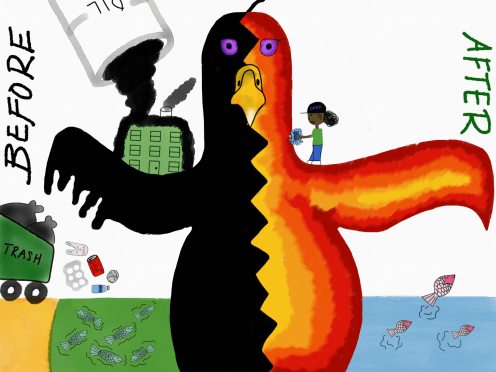
Bre W.– For my SDG I chose number 14, Life Under Water. The main goal of the entire SDG is to conserve and sustainably use the oceans seas and marine resources for sustainable development. The goal of reducing marine pollution of all kinds is represented through my depiction of people, planet, partnership and the environmental and social developments. The reduction of marine pollution through these things is shown through the before and after side; on the before side, there is trash being dumped in the ocean along with oil which pollutes the water and kills the sea life. In addition to that pollution, the dark heavy smoke coming from the factory can also negatively affect sea life. On the after side, there is a volunteer who is partnered with Dawn cleaning the oil off of the bird and there is no trash being dumped into the ocean and the fish are lively. This symbolizes the detrimental impact that industrialization and the improper discarding of waste has on marine life. Placing emphasis on the reduction of marine pollution can ultimately improve the awareness of people concerning the welfare of marine life.

#5

Juan A Poster

Juan A.– This poster represents UN SDG #4 Quality Education. Education is the pivotal factor to success; knowledge is power, and it can give an individual the ability to have a sustainable and happy life. Yet, throughout the global community there are inequalities and inequities stopping so many from receiving an education. In countries like Mexico, where there are no free public schools many families in communities ravished with poverty, are unable to continue to pay tuitions past the 5th or 6th grade. Barriers to an adequate education are prevalent in all countries in the world. The misogyny that is infused in so many societies tops young girls from even entering a school. The deep lack of resources that halts many students from their fullest potential (transportation, hunger, poverty) is seen in developing and developed countries all around the world. To have access to a book or a teacher is necessary for quality education, yet the ability to further one’s education in an equitable manner is also needed to achieve SDG #4. In the US, undocumented immigrants are unable to apply for FAFSA; they don’t receive in-state tuition in 34 states; they cannot receive student loans unless they have a cosigner who is a US citizen; and many scholarships require proof of residency to apply. If the people in a country are given resources to an education, where their merit can establish their success, they will find prosperity and their situation (place) will mirror their quality of life. This partnership between people and an equitable education funded my political institutions will create a more unified and equal planet.

Books

Because the books were electronic documents, I couldn’t share them here, but I did take pictures as the students read them to each other (next year I want to go to a local elementary school and have them read the books to younger students).  It was interesting to see them come up with a conflict related to their chosen SDG, find a resolution to it, and turn that into a children’s book.


Conclusion

I was really impressed with my students’ work.  They showed creativity and a general understanding of the SDGs.  The posters in particular showed just how observant students are of the world around them and the obstacles they face as individuals and that we face as a global community.  Now, more than ever, we need to make sure teaching the SDGs becomes part of school curricula.

Thanks for reading.
Help Us, Europe- You’re Our Only Hope

Since his inauguration, President Trump has made it clear that American foreign policy will be based on the idea of “America first.”  What that looks like exactly is unclear, given the sometimes contradictory messages from various administration officials.  What we do know, however, is that America’s role as a global leader has now diminished so much that US foreign policy is an example of how NOT to approach global issues.  This is especially evident in a number of areas, including the UN and development assistance, NATO, and climate change.

The UN and Development Assistance
President Trump’s FY2018 budget “proposes that the Department of State examine options to: (a) reduce the levels of international organizations’ budgets, (b) reduce U.S. assessment rates, and/or (c) not pay U.S. assessments in full.” (p. 71 of Major Savings and Reforms: Budget of the U.S. Government“)  This would lead to an overall reduction of $786 million for international organizations contributions.

Additionally, in January 2017, Rep. Mike Rogers (R-AL), introduced H.R. 193- American Sovereignty Restoration Act, which called for the US to withdraw from the UN.  While the bill most likely will not become a law, it does illustrate that some members of Congress are taking the “America first” mentality to a whole new level.

If the US does not fulfill its responsibilities with the UN, then it falls upon Europe to fill the void.  On May 17, 2017, UN Secretary General Antonio Guterres spoke at the European Parliament and said that “A strong and united Europe is an absolutely fundamental pillar of a strong and effective United Nations.”  This is especially important given the White House’s current attitude.

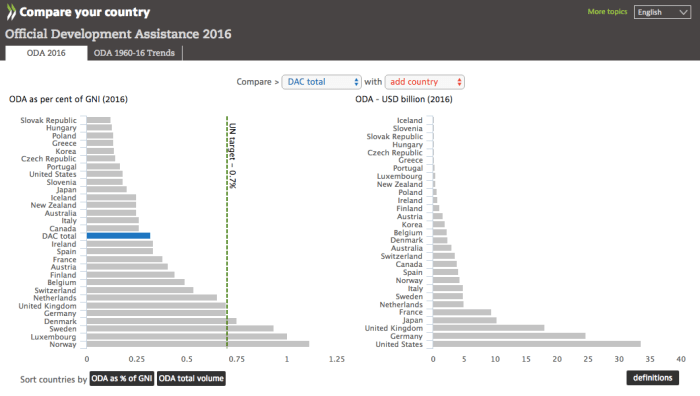
When it comes to official development assistance (ODA), the US has consistently fallen short of the target of .7% of GNI.  In 2016, the US spent .18% of GNI on ODA, placing it eighth worst among OECD countries; however, it was number one in overall spending with $33.59 billion.  Imagine how much good could have been done had the US met the .7% target.  Unfortunately, the outlook is not promising, as President Trump’s budget would eliminate $2.5 billion in ODA (p. 67 of Major Savings and Reforms).

Screen Shot 2017-05-31 at 10.41.18 AM

Even though the US fell short, six of our European allies met or exceeded the .7% target, with Norway leading the way at 1.11%.  For those six countries, the total amount adds up to $54.65 billion, well above the US amount.  The irony here is that while President Trump has chastised our NATO allies for not spending 2% of GDP on defense, the US has not met the target for ODA.

NATO
As for NATO, President Trump spoke in Brussels on May 25, 2017, at the unveiling of the Article 5 and Berlin Wall memorials.  In his remarks, the President pretty much scolded our NATO allies:

“The NATO of the future must include a great focus on terrorism and immigration, as well as threats from Russia and on NATO’s eastern and southern borders.  These grave security concerns are the same reason that I have been very, very direct with Secretary Stoltenberg and members of the Alliance in saying that NATO members must finally contribute their fair share and meet their financial obligations, for 23 of the 28 member nations are still not paying what they should be paying and what they’re supposed to be paying for their defense.

This is not fair to the people and taxpayers of the United States.  And many of these nations owe massive amounts of money from past years and not paying in those past years.  Over the last eight years, the United States spent more on defense than all other NATO countries combined.  If all NATO members had spent just 2 percent of their GDP on defense last year, we would have had another $119 billion for our collective defense and for the financing of additional NATO reserves.

We should recognize that with these chronic underpayments and growing threats, even 2 percent of GDP is insufficient to close the gaps in modernizing, readiness, and the size of forces.  We have to make up for the many years lost.  Two percent is the bare minimum for confronting today’s very real and very vicious threats.  If NATO countries made their full and complete contributions, then NATO would be even stronger than it is today, especially from the threat of terrorism.” 

The picture below sums up the response by the other NATO leaders in attendance.

NATO Leaders Smirk
Photo from Deutsche Welle. http://www.dw.com/en/some-nato-leaders-smirk-others-support-trumps-tough-nato-message/a-38999984

If that wasn’t enough, Trump also pushed the prime minister of Montengro out of the way during the meeting.

A few days after the meeting, Germany’s chancellor, Angela Merkel, said, “The times in which we could completely rely on others are over to a certain extent. That is what I experienced in the last few days… That is why I can only say: We Europeans must really take our fate into our own hands.”

After the trip, Press Secretary Sean Spicer remarked that “the President is acting to strengthen alliances, to form new partnerships, and to rebuild America’s standing in the world.”  The reality, of course, is that threatening to cut funds to the UN and alienating allies weakens alliances and demolishes America’s standing in the world.

Climate Change
President Trump and the White House also have an abysmal record on climate change.  According to the White House website, “President Trump is committed to eliminating harmful and unnecessary policies such as the Climate Action Plan and the Waters of the U.S. rule.”  His budget calls “to eliminate funding in 2018 related to the Green Climate Fund (GCF) and its two precursor Climate Investment Funds (CIFs)” (p. 75 of Major Savings and Reforms).  Furthermore, the budget reduces funding for the Environmental Protection Agency by 31.4% down to $5.7 billion (p. 42 of Budget of the U.S. Government: A New Foundation for American Greatness).  Additionally, the President has made it clear he is no fan of the 2015 Paris Agreement on climate.  As this piece is being written, it is expected Trump will announce the U.S. is withdrawing from the deal.

Across the Atlantic, however, our European allies are committed to fighting climate change.  At a recent UNFCCC conferenceMiguel Arias Cañete, the EU Commissioner for Climate Action and Energy, said, “We came here to Bonn to advance our work on the rules and instruments to implement the Paris Agreement. We leave Bonn with steadfast progress in many areas. And while much work still lies ahead of us, the cooperative talks and the tangible results show once again the unwavering determination of all of us to turn our commitments into real action.”  Quite the opposite from President Trump.  The EU has also adopted a 2020 Climate & Energy Package and a 2030 Climate & Energy Framework.

Conclusion
President Trump’s “America First” foreign policy has left a vacuum of global leadership that could potentially be filled by the EU.  This is a perfect opportunity for bodies like the European External Action Service and EuropeAid to step up and show the world what European cooperation and coordination can accomplish.  For the UN to succeed, and for progress to be made on the Sustainable Development Goals (one of which is climate action), Europe is our only hope.

Thanks for reading.
Constitutional Comparison: Germany and the US

As I was going through my RSS feed this morning, I came across this article from Deutsche Welle on Germany’s Basic Law.  As I read through it, the first thing that struck me was the fact that the very first article in Germany’s constitution discusses human dignity.  This led me to take a closer look at the Grundgesetz, and after further reading, I decided to make a lesson out of it for my class on U.S. government and politics.  We had already studied the purposes of constitutions in general and the US Constitution earlier this semester, so I wanted to compare the two constitutions.

Students noticed a number of differences, among them: 1) Germany put basic rights first, whereas the US put them as amendments; 2) Germany’s constitution is much more in depth than than the US’ (Germany has 141 articles, the US has 7); 3) Germany has an article about the flag, the US does not; 4) Germany has “compulsory military and alternative civilian service,” whereas the US military is volunteer.  We also discussed Germany’s electoral system, even though it’s not explicitly described in the Basic Law.  Out of all these ideas, however, we spent the most time discussing Article 1.1 of the Basic Law- “Human dignity shall be inviolable.  To respect and protect it shall be the duty of all state authority.”  The US constitution has something similar in the Preamble with, “promote the general Welfare.”

We started first by talking about dignity and what that meant.  After that, we looked into the extent to which the governments of both countries fulfilled the idea of human dignity and general welfare.  Since my student charity, VAHSAid, just held an event this weekend to raise awareness of child poverty and food insecurity, we looked for child poverty rates in both countries.  According to the OECD, the latest rate for Germany is 9.8%, and for the US it’s 20.5%.

Screen Shot 2017-05-23 at 1.10.19 PM

Other indicators we looked at (also from the same OECD page):

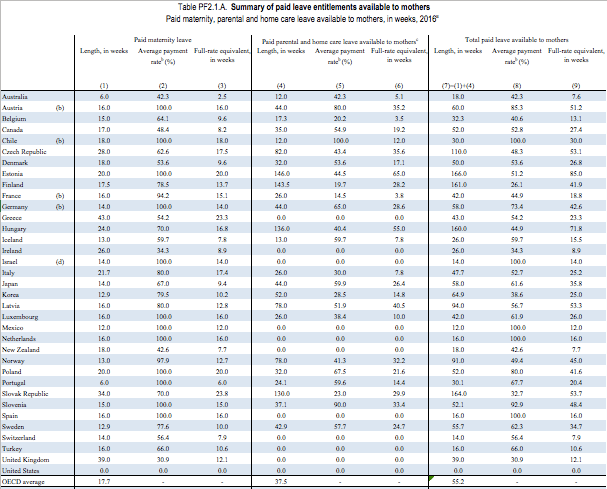
Key characteristics of parental leave systems (total paid leave available to mothers)- Germany: 58 weeks; US: 0 weeks

Screen Shot 2017-05-23 at 1.30.51 PM

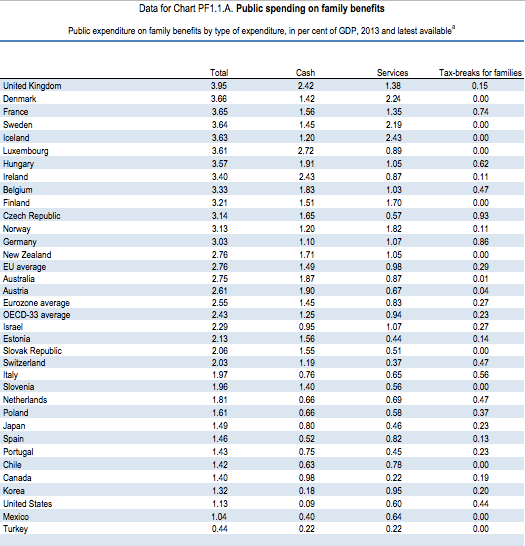
Public spending on family benefits (in per cent of GDP)- Germany: 3.03; US: 1.13

Screen Shot 2017-05-23 at 1.31.59 PM

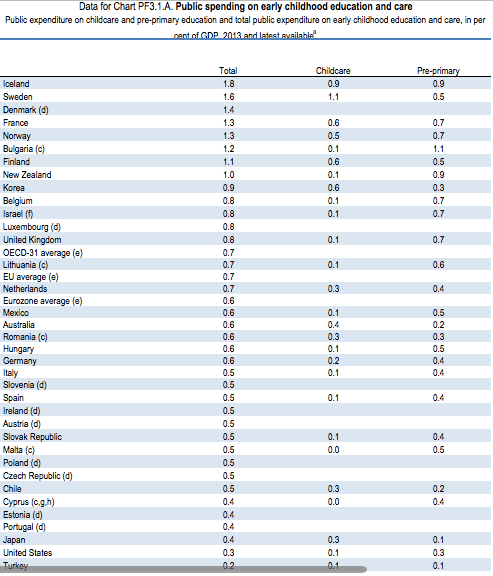
Public spending on early childhood education and care (in per cent of GDP)- Germany: 0.6; US: 0.3

Screen Shot 2017-05-23 at 1.32.53 PM

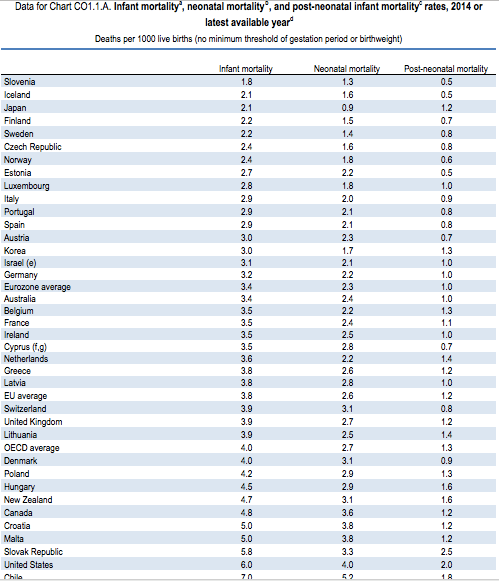
Infant mortality (Deaths per 1,000 live births)- Germany: 3.2; US: 6.0

Screen Shot 2017-05-23 at 1.33.45 PM

After all was said and done, a couple of student observations stood out to me: 1) “Germany takes democracy to a whole new level,” 2) “Germany seems much more about community,” and 3) Students felt Germany’s Basic Law was less ambiguous than the US Constitution and wondered if that would lead to less legal battles or political controversy.

While the original purpose of the lesson was to compare the two constitutions, I am pleased that it led to discussions about issues other than the structure of the governments.  This isn’t to say Germany is some sort of utopia*; however, it does illustrate the need for American politicians to begin emphasizing human dignity in our policies.

Thanks for reading.
*Full disclosure: I was stationed in Germany for 2 1/2 years and have a deep appreciation for the German language, food, beer, and soccer (#NurSGE).

Teaching the SDGs

I’ve recently become more involved with an amazing community on Twitter using #TeachSDGs.  We’re a group of teachers around the world committed to bringing the SDGs to our classrooms and communities.  In just the past two weeks or so, I’ve gained a lot of cool ideas from teachers that I want to use in my own classes, notably making children’s books and creating poems.  This is now my opportunity to give back to this community and share what I do in the classroom.

Letter to the Editor
One of the first actions we can take is to first alert local communities that the SDGs exist and that teachers play a crucial role in achieving them.  To that end, I wrote a general 200-world letter that can be used for most newspapers.

SDGs Poster and Icon Cards
I downloaded the logo and icons from the SDGs website (Note: Make sure you follow their guidelines) and sent the files to a local printer to make the poster and icon cards to use in my classroom and for our VAHSAid events.  As a result, I’ve already had interesting discussions with my colleagues and students who aren’t even in my classes.  I’ve also encouraged my students and colleagues to get their pictures taken with an icon card to share on social media.

Global Summits
Basically, this is like a Model UN conference, only much smaller in scale.

The first is the packet introducing the activity.  We are on a block schedule, so where it says three days, that’s about 280 minutes of class time.  We prepare for the summit the entire quarter (9 weeks), but I usually give them only 3-4 days in class to work on it; the rest of the time is research on their own.

The second document is just a sheet that I cut out to put on the backs of their placards to help with parliamentary procedure (I’ll send a pic of a placard to you via DM).  I also show them the two videos from a model UN conference so they can see what it looks like (https://www.youtube.com/watch?v=QYu9mJz6S3I).  The third document are the rules of procedure (I broke it down from one of the Model UN conferences we attend).

The fourth attachment is the resolution prep guide.  Every summit focuses on two of the SDGs.  So, at the beginning I give them the most current UNGA resolution pertaining to each topic.  Then, they fill out the prep guide, and we go over it next class.

The next two attachments are the country roster and organization cheat sheet.  The last one is the rubric for the whole assignment.

From there, the students mostly work outside of class to prepare for the summit.

As an extension activity, I have the students write a letter to the head of the relevant UN body for one of the two topics, explaining their own personal opinion about what should be done to address the issues.  I’ve included the template I give them.  In the past we’ve written to the UNDP, FAO, UNEP, and UN Women.  The students get quite excited when we receive a letter back.

I am the “chair” for the summit, so I call on countries, keep track of the speaker’s list, and keep notes on what students say in their speeches.

  1. Global Summits
  2. Points and Motions for Placards
  3. Rules of Procedure
  4. UN Resolution Preparation Guide
  5. Country Assignments
  6. Countries and Regional Organizations
  7. Business Letter Format FAO and UNDP

Month-Long Units
Of the four different courses I teach, I’ve put together a month-long unit for three of them.  For World Studies (sophomores) and AP US History (juniors and seniors), I had them pick an EU Member State because I also do a lot of work on transatlantic relations and the EU (in fact, I’m taking eight students to Brussels this summer for a week to learn about the EU).  For AP classes, this unit is a nice way to end the year and have something that is academic, but not overly strenuous.  For the children’s books, I’m using The Children’s Picture Book Project lesson plan.

  1. World Studies- SDGs Unit
  2. AP US History- SDGs Post-AP Test Assignment
  3. AP Comparative Government and Politics- SDGs Post-AP Test Assignment

Children’s Activities
For our VAHSAid events, like our 1st Annual Campout to Stamp Out Child Poverty and Food Insecurity, we have a table for children’s activities.  So far, I’ve developed an SDGs Word Search with key words from each of the SDGs.  I deliberately chose not to give the definitions because I want parents to talk with their children about the terms.  Once I create more activities, I’ll share them.

#TeachSDGs
Finally, I recommend following TeachSDGs and World’s Largest Lesson on Twitter.  I’ve also created a Twitter list of all the amazing teachers who I’ve had the pleasure of talking with about teaching the SDGs.

I hope that you’ll find something useful in all of this.  If you have any questions, please feel free to leave a comment.

Thanks for reading.