Takeaways from the Marshall Seminar on Transatlantic Security

I had the honor of attending the German Marshall Fund’s Marshall Seminar on Transatlantic Security from April 22-24, 2015.  For three days, participants listened to experts discuss the challenges and possibilities in a variety of areas of transatlantic relations.  On the last day, we were asked three questions: 1) What was the most important thing we learned? 2) What will we do with the knowledge? 3) Where is the greatest potential for transatlantic cooperation?  Here are my thoughts on them.

What was the most important thing we learned?
While there were many, many interesting and important points made by the speakers, two ideas really stuck with me.

During the panel on Russia and the Middle East, Ian Lesser said that one of the most important issues in maintaining and strengthening transatlantic relations today is getting the U.S. to see issues/problems through a European lens.  While I agree with his assessment, I think getting both U.S. policymakers and the public to do so will be an uphill battle.  Europe does not receive as much attention in the media as say, Asia (i.e. China) or the Middle East (given our involvement there for over a decade).  A good example of this is the debate surrounding the Transatlantic Trade and Investment Partnership (TTIP).  The U.S. government is not doing a great job explaining and promoting TTIP.  As Rep. Sandy Levin explained recently at the Bertelsmann Foundation, “TTIP is essentially unknown in the US Congress.”  If Congress doesn’t know much about TTIP, what does that say about the public’s knowledge of it?  So, the question we should ask ourselves is how do we get the public and our elected officials to care about Europe?  How should the government (e.g. the State Department, NATO, the US Trade Rep,  etc.) convince the American public that Europe still matters?

The panel on challenges to democracy was informative and gave me a lot to think about.  In his introductory remarks, Ivan Vejvoda brought up the point that democracy is an ongoing process.  Of course, if that is the case (which I believe it is), then is democracy truly attainable?  Brenda Carter, of the Reflective Democracy Campaign, shared some enlightening data concerning political representation and demographics of power here in the U.S.  Here argument that we should apply the same scrutiny to the U.S. as we do other countries when it comes to democracy was certainly thought-provoking.  Finally, Mohamed-Ali Adraoui asked the question, “If some people don’t matter, then what happens to democracy?”  His discussion of identity and exclusion in democracy was certainly relevant in both Europe and the U.S.

What will we do with the knowledge?
As a teacher, I plan on taking the information and turning it into lesson plans.  The panels on climate change and migration, global health, democracy were all very useful and provided ideas for the classroom.  They will be especially useful during my units on the Sustainable Development Goals.  The panel on democracy, as discussed above, is also relevant for my classes on government and politics.

Where is the greatest potential for transatlantic cooperation?
As far as the topics of the panels go, the U.S. and Europe can cooperate on a number of areas.  All of the issues covered were global issues, necessitating global solutions.  No one country can tackle them alone.  While a certain degree of competition among countries will always exist, the U.S. and its European allies must cooperate and work towards multilateral solutions.  Policymakers on both sides of the Atlantic can learn from each other; however, that requires a greater degree of flexibility and innovation than currently exists.

I also believe, as I have written before, that teachers need to be more involved to promote transatlantic relations.  I am developing the rough outline of a possible teacher program that I hope to share with relevant parties (and perhaps on this blog) in the near future.  If we want the public to understand why Europe still matters to the U.S. and to see global issues/problems through a European lens, teachers must be involved.

Attending this seminar was the best professional development I have had in my thirteen years as a teacher.  I would love to attend more like it and even apply for fellowships or programs whose goals are to maintain and strengthen transatlantic relations.  Ideally, I would prefer to leave teaching and work full time on such matters.  Unfortunately, as I look for such opportunities, I realize that as I fast approach 40 years old, my chances are limited.

Thanks for reading.

Marshall Seminar Background Reading: Part I

Last year the German Marshall Fund held a blog competition on transatlantic cooperation.  Participants were asked to write entries on “what has the transatlantic relationship meant to you, and how can we preserve it and make it even stronger for future generations.”  I entered and wrote a piece titled, “Teachers and the Transatlantic Relationship,” and much to my surprise, I was chosen as an honorable mention.  As a result, I have the honor to attend the GMF’s Marshall Seminar on Transatlantic Security.

When I saw the preliminary agenda for the Seminar, I was quite excited.  I finally have the chance to talk with others who are as interested as I am in maintaing and strengthening transatlantic relations.  To prepare for the seminar, I starting looking for articles on each topic.  I was not looking to become an expert, but I wanted enough to have some sort of knowledge so that I can follow the discussions and maybe ask a question or two.  I have now made my way through about half of the reading, and I wanted to share them, in case somebody else out there is interested in the topics.

General Reading
The North Atlantic Treaty with Accession Protocols– Articles 4, 5, and 6 are especially important when we start talking about concerns by Eastern European members about Russia and the situation with ISIS along the Turkey-Syria border.

NATO in an Era of Global Competition– If I were to pick a few ideas that stuck out to me: 1) impact of fiscal austerity, 2) how to build public support for NATO, and 3) the opportunities for the U.S. and Europe to collaborate on more than just security/defense.

NATO at a Crossroads– Short set of recommendations, but a lot to think about.  In particular, the recommendation on the need for more public diplomacy from NATO, especially for younger generations, resonated with me.  To my knowledge, NATO does not have anything on its website geared to educators in Member States that would help with that.

Wales Summit Declaration– Good to get a sense of what leaders see as important for NATO and what they foresee in its future. Addresses most of the topics for the Marshall Seminar.

Munich Security Report: The section on “Challenges” (e.g. hybrid warfare, war on terror, refugees, etc.) is especially useful.  I also appreciated the fourth section, “More Food for Thought,” which gave recommendations for further reading.

New Face of Warfare and How to Deal with Russia and the Islamic State
Counter-Unconventional Warfare is the Way of the Future. How Can We get There?– The definition of hybrid warfare was useful, as was the discussion differentiating counter-unconventional warfare from counter terrorism and counter insurgency.

Deterring Hybrid Warfare: A Chance for NATO and the EU to Work Together?– Argues that NATO and the EU working together creates more flexibility when it comes to deterring adversaries.  Mentions the work the EU has done in the realm of Security Sector Reform.

Energy as a Part of Hybrid Warfare– Discusses three actions Russia has taken using energy as part of its hybrid warfare in Ukraine. Great point at the end about Russia acting alone as a single state as opposed to the West, which has to coordinate actions, thereby giving Russia an advantage.

Russia’s Hybrid Warfare: A Success in Propaganda– Interesting discussion of the evolution of Russia’s use of traditional and social media in framing the narrative and how Western media has played a role in its current success.

Preparing Finland for Hybrid Warfare: Social Vulnerabilities and the Threat of Military Force– Argues that “societal preparedness” must be part of a response to hybrid warfare and gives five recommendations.

Nothing New in Hybrid Warfare: The Estonian Experience and Recommendations for NATO– Fascinating section on Estonia’s experience with Russia’s historical use of hybrid warfare. Great point that “It is the combination and orchestration of different actions that achieves a surprise effect and creates ambiguity, making an adequate reaction difficult, especially for multinational organizations that operate on the principle of consensus.”

Nonviolent Civilian Defense to Counter Russian Hybrid Warfare– Argues that nonviolent actions taken by civilians can be more effective and less costly than military measures.  Uses historical examples of Denmark in the Second World War and Czechoslovakia in 1968.

The Future of Conflict– Brussels Forum panel including Gen. Philp Breedlove, Michele Flournoy, Yang Jiemian, and Marwan Lahoud.  Gen. Breedlove’s discussion of hybrid warfare, his use of the “DIME” model (diplomatic, informational, military, and economics), and his idea of an “all of government approach” was especially useful.  Best quote about information warfare came from him- “the way to attack the false narrative is to drag the false narrative out into the light and expose it.”

The Threshold for Collective Defense- Article 5 and Emerging Threats
Collective Defence– Basic information from NATO. Includes a section on collective defense in regards to Ukraine.

How to Avoid Wars: NATO’s Article 5 and Strategic Reassurance– Recommends that NATO “react strongly to Russia’s aggression.”  Also urges NATO to be more reactive, rather than proactive, when it comes to “new risks.”

Article 5 Revisited: Is NATO Up to It?– The discussion on Article 4 of the NATO Treaty is thought-provoking, as is the question posed at the end of the paper- “If not now, when?”

How NATO’s Article 5 Could Work in the Case of Turkey– Important to think about in terms of the threat to Turkey posed by ISIS.

I will try to post my thoughts on the next two Seminar topics soon.  If you have any other recommendations or thoughts, please let me know.

Thanks for reading.

Gov. Walker’s #1 Priority

According to this tweet from Gov. Scott Walker, the most important issue that needs to be addressed above all else is border control.

Screen Shot 2015-04-09 at 5.10.36 AM

Not increasing jobs and growing the economy.  Not improving public education and reducing college tuition.  Not addressing the alarming rate of poverty.  None of those.  The problems associated with those issues are nothing compared to to border control.  This is how he plans to revive America- by securing the border?

To quote the snooty waiter from Ferris Bueller’s Day Off, “I weep for the future.”

Thanks for reading.

Workers of Wisconsin, Unite

As I’ve followed the past week’s protests at the WI state capitol concerning, AB 61, the “Right to Work” bill, I thought back to the 2011 protests.  That year, I was the vice-president of our union, and I remember my email being flooded the weekend after Gov. Walker introduced the now-infamous legislation regarding collective bargaining.  I spent the weekend reading the proposed legislation and wrote a speech to give that Monday in front of the Joint Committee on Finance.  The next two days of protests were electrifying, and I was proud to have been part of them.

Fast forward to today, to the Public Hearing on AB 61.  My Twitter feed blew up with commentary about testimonies, and it made me nostalgic about my testimony.  I searched through WisconsinEye and eventually found it.  I was unable to embed it into this post, so you’ll have to click on this link, choose the video that’s almost 17 hours in length, and fast forward to 3:21:47.  If I seem bouncy, it’s because I was both nervous and excited.

If you have any thoughts on my testimony or the current “Right to Work” bill, feel free to leave a comment below.

Thanks for reading.

Rebuilding US-German Relations

The February 7th edition of The Economist left me with mixed emotions.  On the one hand, as a proud German-American, I was quite pleased to read an article titled, “German-Americans: The Silent Minority.”  On the other hand, I was disheartened when I read the piece, “Germany and America: Ami Go Home.”  The first piece was nice because it discussed the legacy and traditions of Germans here in the U.S. (and in particular my state of Wisconsin).  The second article, however, is the one that I’ve been thinking about for the past two weeks.

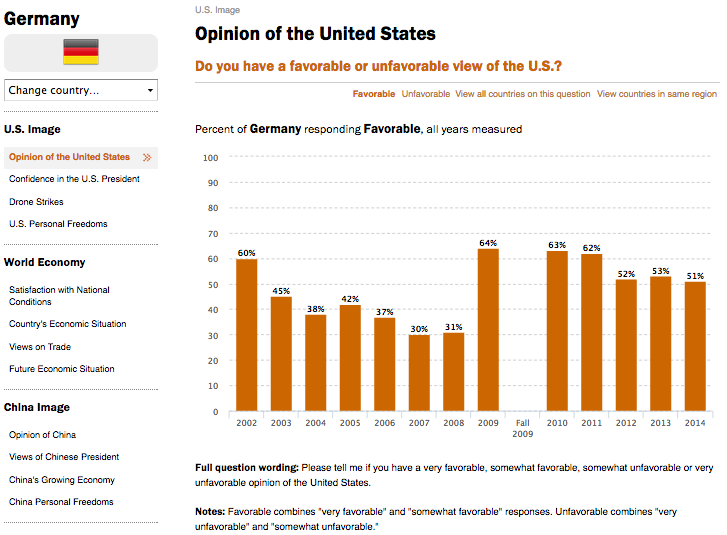
Since the “Ami Go Home” piece only presented data on support for the Transatlantic Trade and Investment Partnership (TTIP), I want to present some other data concerning Germany’s sentiment towards the United States.  First, the most recent polling data (July 2014) from the Pew Research Center shows that only 51% of Germans have a favorable view of the U.S.  This puts Germany in the category of Top 10 Global Critics of the United States.

Source: http://www.pewglobal.org/database/indicator/1/country/81/

Second, a June 2014 article in the Wall Street Journal had this to say about relations between the two countries: “German government officials readily acknowledge that anti-Americanism—fueled most recently by revelations of National Security Agency surveillance activities in Europe—plays a significant role in how the public perceives the Ukraine crisis and has bred a reluctance among many Germans to side with the U.S.”  The piece also included polling data with a very telling caption.

Source: http://www.wsj.com/articles/in-germany-anti-american-sentiment-fuels-push-to-tread-softly-on-ukraine-1402443505

Given the importance of the transatlantic community in facing current global challenges, and recognizing the role that German plays in European politics, it is in the best interests of the United States to improve relations with Germany.  The question now is how to best go about that.  What follows are four programs that could help with the rebuilding process.

The 2014 Comprehensive Annual Report on Public Diplomacy and International Broadcasting Activities lists a number of programs that could help reduce German anti-Americanism (in fact the report has a “Spotlight” on Germany on pp. 168-169.)  In the Bureau of Educational and Cultural Affairs, there are two programs designed to build relationships between youth on both sides of the Atlantic.  The German-American Partnership Program connects German and US secondary schools.  My school has something similar, and it has been a valuable program since it started.  The three Congress-Bundestag Exchanges (Youth, Vocational Youth, and Young Professionals) provide American participants the opportunity to learn the German language and gain academic or work experience in Germany.  Along those lines, the Congress-Bundestag Staff Exchange is designed to “help Americans and Germans learn about each others political institutions and discuss issues of mutual concern.”

In addition to the federal government, two Washington, DC-based think tanks offer programs to strengthen US-German relations.  The German Marshall Fund runs the Congress Bundestag Forum, “a parliamentary exchange that brings together members of the German Bundestag and members of the U.S. House of Representatives for a series of discussions on areas of mutual concern.”  The Atlantic Council established the US-German Next Generation Project, designed to bring together “experts in key issues for the bilateral relationship, such as economic/business cooperation (TTIP, energy), defense/security cooperation (NATO, Russia, Iraq, Syria), the internet/privacy/cyber and intelligence cooperation, scientific cooperation and US-German cultural and educational exchange.”

Finally, I encourage readers to visit the websites of the following organizations devoted solely to this topic:
1) The American Institute for Contemporary German Studies
2) The American Council on Germany
3) The Goethe Institut
4) The German Academic Exchange Service

US-German relations have slowly deteriorated the past few years and took a big hit in the wake of the NSA scandal.  Given the importance of Germany to the U.S. economy and in dealing with Russia, it is incumbent upon the U.S. to build them back up.  If you know of any other programs that should be mentioned here, please mention them in the comments below.

Thanks for reading.