My Experience in Brussels with Public Diplomacy

A few weeks ago I wrote about Sen. Russ Feingold’s book and public diplomacy.  It only hit me today that I I’ve already engaged in a form of public diplomacy, back in 2011, when I traveled to Brussels with a group of American professionals.  What follows is my reflection written for the UW-Madison EU Center of Excellence upon my return to the US.

During the week of June 20, 2011, I had the opportunity to travel to Brussels learn about the European Union and EU-US relations.  Given the fairly recent adoption of the Lisbon Treaty in 2009, as well as the prominence of the Eurozone crisis, we were there at a time of not only transition, but also of extreme importance for the EU.

Our first stop was the European Commission, where we were given a general introduction to the EU and its institutions.  One of the ideas that our contact presented to us was to equate the EU with the concept of the glass being half full versus half empty.  Given the problems plaguing the EU- the notion of a democratic deficit, the problems with the Eurozone, foreign and defense policy, etc.- many critics see the EU as an experiment gone wrong.  The other view, however, is to examine the EU through an historical lens.  If we see how far Europe has come since the first half of the twentieth century, then the EU is an experiment that has succeeded.
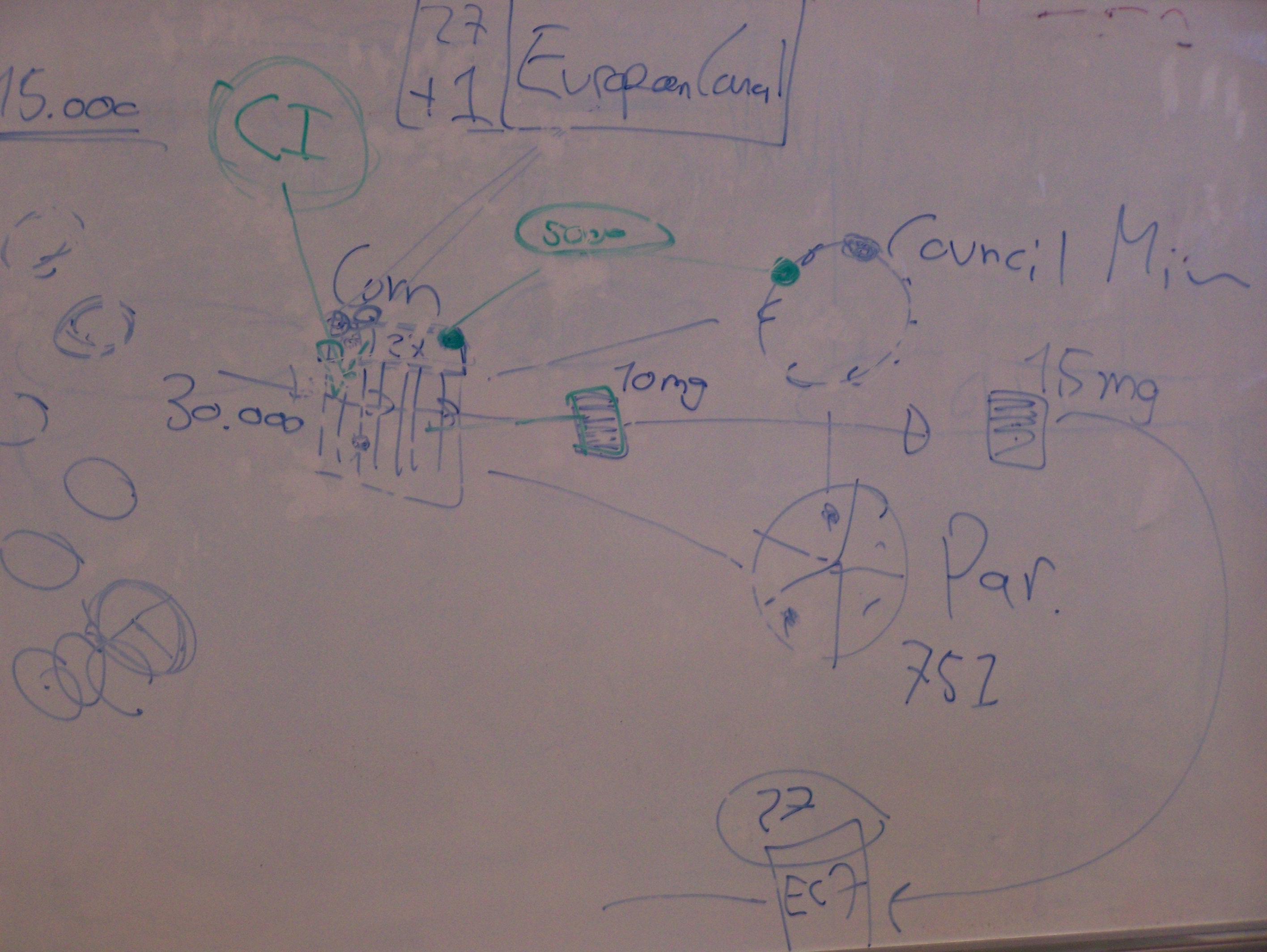
Part of our presenter's diagram explaining the EU.
Part of our presenter’s diagram explaining the EU.

One of the ways in which the EU is trying to reach out to the citizens of the Member States is disseminating information.  Since the EU is not thoroughly taught in European schools, the EU has numerous means for people to find out about it.  While the EU’s website is the best place to go for information ranging from basic information, policy areas, and the institutions themselves, it is immense and can be quite confusing.  As a result, the EU has several information offices where visitors can pick up a plethora of pamphlets and posters in a variety of languages.

While the entire trip was about learning about the EU, we also had three different opportunities to learn about EU-US relations; one such place was the US Mission to the EU.  I was quite surprised to learn that when the EU holds talks about enlargement, the US is invited to some of them.  This is especially evident with the issue of Turkey.  That same day, we had three presentations by members of the newly created European External Action Service.  All three presenters were members of the US and Canada Unit.  Our first briefing was about general EU-US relations.  Given the special relationship between the US and Europe that developed over the course of the twentieth century, the current relationship between the EU and the US is of extreme importance.  This can be seen in trade relations between the two sides, the subject of our second briefing.  Our final briefing by the EEAS covered energy and environment issues, two issues with which both sides have problems, especially dependency on foreign supplies of energy.  Our final briefing of the trip concerning EU-US relations took place at NATO headquarters.  Here we learned about the different perspectives that both the EU and US bring to the table concerning NATO issues.

100_7366

Besides the chance to see Brussels, perhaps the highlight of our trip was our experience at the European Parliament.  While our session at the EP was planned, what we saw there was not.  Due to the Eurozone crisis, the EP had called a plenary session for the day we visited.  Not only did we get to see the outgoing Hungarian President of the Council of the European Union give her farewell speech, but we also got to see the President of the European Commission, José Manuel Barroso, speak about the Eurozone crisis.  Needless to say, we were all excited that we got to see both officials speak.

All in all, this trip was a success.  The EU is a fascinating experiment in cooperation and integration, and as an educator, I hope to bring a lot of this information back to my classroom and add it to what I already teach about the EU.  Additionally, I hope that I can begin forging transatlantic relationships of my own to bridge the gap between Americans and Europeans.  Finally, I urge my fellow educators to take advantage of the workshops and other opportunities offered by the UW-Madison EU Center of Excellence and to check out the websites of both the European Union and the EU Delegation to the USA.

**Follow-up comment from August 20, 2013: Since my trip I have continued my interest in the EU and transatlantic relations. Some day I hope to go back to Brussels and even other European cities to spend more time learning about the EU and building transatlantic relationships, especially with educators.  If you happen to know of a program designed for Americans to engage with European professionals (policymakers, journalists, educators, etc.) for any length of time, please let me know.  Thanks.

Foreign Policy Observations and Advice from Sen. Russ Feingold

This past spring I checked out from the public library Russ Feingold’s book, While America Sleeps: A Wake-up Call for the Post 9/11 Era, and as soon as I finished it, I went out and bought my own copy.  Throughout the book, Feingold, the former Democratic US Senator for my state, Wisconsin, gives an interesting behind-the-scenes account of Washington after 9/11 and his time as a member of the US Senate Committee on Foreign Relations.  As he recounts his days as a politician, he simultaneously makes observations and doles out advice for American foreign policy.

One of the main themes of the book is the necessity of the American people and government to be more aware of foreign affairs.  Towards the beginning of the book, Feingold quotes a 1937 speech by Winston Churchill, during which the former British Prime Minister states, “[Our] fate…depends on what may happen in the world, on what other countries do, for good or for ill.” (16)  Seventy-six years later, that advice is still applicable, if not more so, given our increasingly interconnected world.  In his numerous discussions of listening sessions, Feingold mentions how often constituents’ questions and comments focused on domestic issues as opposed to global ones.  Eventually we learn that political conversations at all levels focused mostly on domestic affairs, and that “there is little expectation within the Senate that senators should know much about foreign issues; expectations are even lower among the public as well.” (236)  Additionally, he asserts that people living in other countries know more about Americans, than we do about them.  This leads to the important conclusion that the US will experience serious repercussions for ignoring the rest of the world.  Not only will deliberate ignorance have a detrimental affect on our standing in the world, but it will also have negative consequences for our national security.

This leads us to the second theme, his advice on how to correct this problem and get America back on the right path.  I want to focus on two of his proposals- learning at least one foreign language, and the importance of public diplomacy.  Sen. Feingold devotes roughly four pages to the issue of learning a foreign language.  I do not know why this is not more of a priority in our education system, although I can guess it is because the US borders only two countries- Canada and Mexico- and therefore learning another language has never really been seen as a necessity.  Last spring, I traveled to Germany as part of an exchange program between my high school and a Gesamtschule.  I was amazed at how early students there begin learning English.  On top of that, many of them usually learn a third language.  Of course, I can see why learning a foreign language might be a necessity in Europe, given the fact that any one country borders many different countries.  As globalization continues, it is imperative that Americans learn foreign languages.  If we want to conduct business in other countries, study overseas, or even just learn about another culture, learning a foreign language is crucial.

In addition to learning a foreign language, Feingold advocates for the importance of public diplomacy.  While he states that lawmakers and diplomats need to be “engaged and informed about world affairs,” we also need regular citizens to travel overseas to cultivate relationships and understanding between the US and other countries. (248)  Feingold argues that public diplomacy will create “meaningful opportunities for citizen dialogue, a chance for countries to get to know each other from the bottom up.” (264)  Perhaps the most well-known attempt by the US government at public diplomacy is the Peace Corps.  As a high school social studies teacher, I am a firm supporter of public diplomacy.  One of the classes I teach is World Studies, a mix of history, government, geography, and economics.  During the thirty-six weeks we are in school, my job is to teach my students (who are mostly 15-16 years old) about various regions around the world using those “strands” of social studies.  In other words, I am trying to increase my students’ interest and awareness in global affairs and cultures, as well as break down stereotypes.  As I am sure that classes like this are found all over the world, who better to engage in public diplomacy than teachers?  Accordingly, I want to point out two specific opportunities for teachers.

The first program is the Fulbright Classroom Teacher Exchange, an opportunity for a teacher from the US and another country to exchange positions for a semester or a year.  Unfortunately, there are only six other countries participating in the program.  I hope that whichever agency is in charge of the Fulbright (US Department of State?  Institute of International Education?) will eventually be able to add more countries to the list.  As someone who has a keen interest in transatlantic relations, the second program I want to point out is the Marshall Memorial Fellowship created by the German Marshall Fund of the United States.  Participants “visit five cities during the 24-day program” and “explore each other’s politics, business, innovation, and culture through experiential learning.”  Given the importance of the relationship between the US and Europe, programs like this one are beneficial to parties on both sides of the Atlantic.

Since 9/11 and the debacle known as the Bush Doctrine, the US has lost its standing in the world.  We have a lot of relationships to mend.  Russ Feingold has given the American public and politicians a blueprint for a successful foreign policy.  Hopefully, more people will read his book and take his advice.

Lessons I’ve Learned from Commuting by Bicycle

I began bicycling in September 2010 for two reasons- the health benefits and to commute to work.  Living in Madison has made commuting a great experience, and I wanted to share some of the lessons I have learned the past three years.

1. Before you begin commuting, ride your expected route at least once, if not twice.  Look for bike lanes that you can use.  If your route takes you down a busy street and you don’t feel safe, find a parallel side street that you can take.  You should also find out if there are paved bike trails in your area.  Finally, check out the WI Department of Transportation’s webpage with bicycle maps.

2. If you don’t remember what you learned about bicycle safety as a child, brush up by going to the WI Department of Transportation’s webpage for safety tips and rules for riding.

3. Depending on the distance of your commute, you might want to consider buying a pair or two of bike shorts.  My commute is 40 miles round trip, and I learned the hard (and very painful) lesson of riding long distances without proper gear.

4. Consider buying both a headlight and taillight.  This is especially important if you will be cycling in the dark.  If you will not be riding in the dark, they still increase your visibility with automobiles, thereby making your commute that much safer.

5. As a teacher, I bring a lot of work home with me; therefore, I decided to buy a basket big enough for my backpack and laptop.  I tried riding at first with my backpack on my back, but by the time I got home at night, I was uncomfortable.  If a basket isn’t your style, you could always choose a cargo bag or pannier.

6. If you work up a sweat on your commute, make sure your place of employment has a shower facility and place to change.  To decrease the amount of gear I need to take to work with each commute, I take a towel and a few days worth of clothes to work on Sunday.  I have a cupboard in my classroom, so I can store my “dirty” clothes in there for the week until the following Sunday.

7. Finally, if you live in the Madison area, you might want to check out the Choose to Commute workshop put on by the Wisconsin Bike Federation.

There are many other steps you can take to increase the comfort of your commute, but the above recommendations should be enough to get you well on your way.  Commuting really boils down to two very simple, but important, principles- the 6 P’s (Proper Prior Planning Prevents Poor Performance) and SAFETY.

Happy Commuting.

Forward Together

A funny thing happened on the way to the 2013 Democratic Party of Wisconsin convention- my car broke down.  Lucky for me, however, it happened in the parking lot of the convention center.  Smoke came pouring out from under the hood and anti-freeze spilled onto the pavement.  Not a great way to start my first convention.

Since I had arrived a bit early, I walked through the Democratic Unity Fair, waiting for registration to begin.  I was very pleased to see how many organizations and groups had booths devoted to advancing the progressive cause here in Wisconsin.  The first table I stopped by was hosted by the Center for Progressive Leadership.  The main goal of the CPL is to provide training to develop progressive political leaders.  I was so impressed that I applied for the 2014 Fellowship program.  Similar to the CPL is Wisconsin Progress, a “state-based candidate recruitment and training program.”  For somebody like me, who has a keen interest in politics and has contemplated running for office, both organizations seem to have a lot to offer.  The final booth that I stopped at was run by Progressives United, a group devoted to campaign finance reform.  I was especially excited to learn that former Senator Russ Feingold, the group’s founder, would be at the convention and at a hospitality event late Friday night.  I happened to have my copy of his book, While America Sleeps, and was hoping to have him sign it.  Unfortunately, due to my car problem, I had to leave the convention early and missed out on my chance.  If you have not read the book yet, pick up a copy today.  (I’m actually reading it for the second time as of this writing.)

The convention finally kicked off around 6:00 with speeches lasting past 9:00 (unfortunately, I had to leave at 9:00 and missed Rep. Kind, Sen. Baldwin, former Sen. Feingold, and San Antonio Mayor Julian Castro).  One of the big themes of the night was Gov. Walker’s poor performance concerning Wisconsin’s economy and job creation (or lack thereof.)  Every speaker that I saw mentioned this topic.  Milwaukee Mayor Tom Barrett even joked that the Wisconsin GOP’s new bumper sticker read, “Take that Wyoming,” referencing the fact that Wisconsin ranks ahead of only Wyoming in a recent economic forecast.

As a history teacher, I was pleased to hear overwhelming support for public education and references to James Madison, constitutional amendments, Robert La Follette, and  Gaylord Nelson.  Mayor Barrett, referencing a recent GOP attempt to limit voters’ rights (and thereby decreasing the size of the electorate) in Wisconsin, discussed a number of US constitutional amendments that increased the size of the electorate.  State Representative Peter Barca talked about the Wisconsin tradition of progressive reforms begun by La Follette and continued by Nelson (the founder of Earth Day).

On the topic of public education and the fight against Gov. Walker’s voucher plan, Mahlon Mitchell, President of the Professional Fire Fighters of Wisconsin, said that “public dollars should go to public education.”  Mayor Barrett echoed those sentiments, declaring that “we are all committed to public education.”  Finally, state party Chair Mike Tate, argued that “having great public schools is the great equalizer.”

Another theme of some of the speakers was the need for unity and working together (the theme of the convention is “Forward Together.”)  Larry Nelson, the Waukesha County Board Supervisor (and my 8th grade English teacher), spoke of the necessity of working with independents and open-minded Republicans.  Mike Tate discussed the 72-county strategy and the importance of working together for that to succeed.  Finally, Congresswoman Gwen Moore spoke of a 3-D Democratic Party, one that is “Diverse, Daring and Driven.”  In other words, the Party needs to embrace all people of all lifestyles, creeds, color, socioeconomic status, etc.

While I agree that the Democratic Party is much more tolerant and inclusive than the GOP, I did witness an unfortunate incident that seemed to contradict that message.  During the resolutions debate on Saturday morning (a session not well-attended), a young man sat in the audience.  He was talking a bit loudly and was messing with his cell phone.  After a few minutes a woman sitting in the row with him and went over to ask him to quiet down.  When the young man continued, a gentleman in the row behind him went to him and pointed to the doors in body language suggesting that the young man leave.  A second gentleman shook his head and moved away from the young man.  After a few more minutes the young man finally got up to leave.  The gentleman who had moved away returned to his seat, once again shaking his head.  Now, I had sat next to the young man the night before in one of the hospitality suites and based on the conversations he had with another patron and his behavior Saturday morning, it was quite obvious that he had special needs.  Perhaps because I am a teacher and see people with special needs on a daily basis it was obvious to me but not to the other audience members.  I was so upset with the behavior and actions of those men that I left the debate and decided to leave the convention.  Thankfully, I was able to speak with a member of the staff and he said he would look into the matter and apologized.  If the Democratic Party is going to be the Party of the people and embrace diversity, it cannot ignore those with special needs or disabilities.

Despite that incident, it was a great convention.  The progressives of Wisconsin are energized and ready to take back the state in 2014.  Together, we will move Wisconsin forward.

Employment in Wisconsin

Recently, Eurostat released information about unemployment in the Euro area, and it got me thinking about employment in Wisconsin.  When Governor Walker ran for office in 2010, one of his campaign promises was to create 250,000 jobs in Wisconsin.  I took a look at the statistics from the U.S. Department of Labor, and here is what I found.

From January 2011 through February 2013, the total employment in Wisconsin has gone from 2,830,856 to 2,838,397 (although the February numbers are preliminary).  That’s an increase of almost 8,000; not exactly close to 250,000.  If we take a look at Nonfarm Wage and Salary Emplyment (in thousands), however, Wisconsin in 2011 was at 2745.4,  and the preliminary numbers for February 2013 are at 2809.9– an increase of 64,500.  Better than the total employment, but still far off from his promise of 250,000 jobs.  In its Fall 2012 Wisconsin Economic Outlook (WEO), the Wisconsin Department of Revenue predicts that a total of 36,000 jobs will be created by the end of 2013.  Assuming that those are Nonfarm jobs, that would bring his total job creation in three years to just over 100,000.

As for the unemployment rate in Wisconsin, according to the US Department of Labor, in January 2011 it sat at 7.7%.  The lowest rate was in December 2012 at 6.7%; however, the preliminary rate for February 2013 is 7.2%.  While the US Department of Labor has a trend of an increasing unemployment rate, the Fall 2012 WEO predicted that the rate will drop to 6.8% for 2013.  Here’s how Wisconsin compares to the rest of the Midwest (IL-IN-IA-MI-MN-NE-ND-OH-SD-WI) in the same time:

State; Jan 2011; Feb 2013 (Preliminary)
IL; 9.4; 9.5
IN; 9.0; 8.7
IA; 6.1; 5.0
MI; 11.0; 8.8
MN; 6.8; 5.5
NE; 4.5; 3.8
ND; 3.6; 3.3
OH; 9.0; 7.0
SD; 5.1; 4.4
WI; 7.7; 7.2

It appears that Gov. Walker still has a lot of work ahead of him, so I’ve taken the liberty here to propose two ideas that will create jobs and help Wisconsin in other ways.

First, improve our infrastructure.  I’m not not talking merely fixing existing roads, highways, and bridges.   While those are important and would help with the construction sector, I propose that we begin seriously bolstering our public transportation system (bus AND rail.)  Think about some of the possible jobs that would be created- drivers/conductors, railway construction, construction for bus and train stations, staff to maintain those stations, and maintenance for the fleet.  Roads would be less congested and the impact on the environment would be tremendous.  If transportation becomes easier, quicker, cheaper, and cleaner, people would be more inclined to travel, thereby helping out our tourism industry.  And as well know, Gov. Walker emphasized the importance of tourism to Wisconsin’s economy in his 2013 State of the State address.

Second, spend more money on public education.  I think Rob Lowe’s character on the West Wing, Sam Seaborn, made a great point about what our public education system should be like when he said, “Education is the silver bullet.  Education is everything.”  We need to train teachers and increase the teacher workforce.  Not only will this help our already excellent university system (i.e. colleges of education), but it will positively affect our K-12 public education.  If we have more teachers, we can begin to decrease the teacher-to-student ratio.  From there, the possibilities for improving students’ success in education are endless.  We should also spend money on improving the school structures (schools themselves, playgrounds, etc.).  Not only would this require construction jobs, but it would also improve the learning environment, once again increasing students’ chances of  success.  Additionally (and this is the selfish teacher in me speaking), if teachers teach in state-of-the-art schools, have less students, and are respected, then teaching can become even more enjoyable than it already is for many of us.  If more teachers enjoy teaching, we can increase our retention rates.  In a November 2012 piece, US News reported that in high schools alone, “More than 30 percent of new educators quit teaching after three years, and nearly half leave before hitting the five-year mark, according the nonprofit National Commission on Teaching and America’s Future.”  Finally, instead of spending money on vouchers, spend it on our public education system.

These two ideas, along with others, could have Wisconsin setting the standards for others to emulate.  It’s time to move Wisconsin forward.