The ECFR Scorecard and the US (Part I)

Last week, the European Council on Foreign Relations published its third annual European Foreign Policy Scorecard.  While there are numerous areas analyzed in the Scorecard, I want to focus on the discussion about the US.  This post will cover just the introductory sections, and in my next post I will discuss the scores in the specific areas.

As a firm supporter of the necessity of strong transatlantic relations, I was pleased to see that two of the top four most successful policies in 2012 concerned the US.  What is perhaps more interesting to note of the most successful policies, is that of the four dealing with the US, three relate to cooperation towards issues in the Middle East/North Africa.

I was a bit concerned, however, at the lack of attention given to the US in the Introduction to the Scorecard.  The editors devoted a paragraph each to summarizing relations with Russia and China, but when I got to the paragraph with the US, there was only one sentence about the transatlantic relationship.  After that, they quickly moved on to multilateral issues.  I initially thought of two possible reasons for this lack of coverage. First, it could be symbolic of a European pivot away from the US.  After all, if the US were pivoting towards China, then why wouldn’t Europe focus on Russia and China?  Second, it could just be that since the US does not pose as big of a concern to Europe as Russia and China do, the editors felt more inclined to devote more attention to those two nations.  Or, perhaps it could be a combination of the two.

Overall, it appears that score for relations with the United States has improved; however, the grade, a B-, has not changed since 2010.  This seems problematic as one would hope to see greater improvement in relations between the two parties.  While the Scorecard focuses on European performance in the relationship, it should be noted that the US must accept some of the responsibility for lack of better relations.  Leaders on both sides of the Atlantic should be asking the same questions.  What can we do to improve our relationship, especially during this time of economic crisis?  What can we learn from each other to address some of our own internal problems?  What can we do together to address pressing transnational issues like climate change and nuclear proliferation?  (I bring up the example of climate change especially because European relations with China on climate change received a higher score than relations with the US on climate change.)

The Introduction to the section about EU-US relations brought up some provocative points.  First, the editors propose that “the G20 world is not yet a reality.” I find this to be an interesting choice of use of the word “yet,” as if to imply it is eventually going to happen.  Does this mean that the editors do not agree with Ian Bremmer’s argument about a G-Zero world?  If so, I wonder if we’re getting a glimpse of optimism from ECFR with the sense that both Europe and the US will pull through the crisis together and provide the world with much needed leadership.

Building off of that, we read that “Europe, with all its flaws, [is] the only dependable partner the US has.”  I agree that this is the case, but I’m curious to see how Europe might possibly use this information to its advantage.  Will the EU start asking the question posed by Jan Techau, “What is in it for us?”  Is this possibly the beginning for Europe to take more united stands against the US?  If so, can the US afford to ignore Europe if they differ on issues?  Conversely, can Europe afford to take a stand with the possibility that the US will merely shrug off any sort of disagreement?  I think what we have here is a situation where both sides need each other and must recognize that before the relationship deteriorates.

In my next post, I will discuss what I feel were some of the more interesting points within the scores.
Congress and the Middle Class

As I was preparing for the mock campaign in my Government & Politics class, I came across an article by Linda Fowler titled, “Who Runs for Congress?” (Political Science and Politics, Vol. 29, No. 3, Sep. 1996)   In it, Fowler mentions that “at least fifty members [of Congress] are worth $2.5 million or more.”  That was in 1996.  Fast forward to 2012, and we see that almost half of all legislators are millionaires.  Fowler then goes on to discuss who can actually run for Congress.  Here, she argues that one of two types become candidates- those that have the time to devote to running a campaign and soliciting donations, and those that have personal wealth.  What this means is that those who actually run for office either have jobs that allow them to be away from work while still receiving a paycheck, or they have a spouse who makes enough money to pick up the slack.  Pierre Guerlain, in his article about American decline, reaffirms this notion that “only the rich can even run in elections.”

So, if the wealthy are the ones running in elections, who eventually makes their way to Washington?

Recently, Businessweek broke down the members of the 113th Congress into an enlightening graphic.  What we see is that over half of the members of Congress fall into one of three occupational categories- businesspeople, lawyers, or career politicians and government employees.  It seems to me that these three categories would give the candidates enough money to be able to run for office.   It also leads me to question whose interests are being represented.  I should also note that my three representatives in Congress- Sen. Tammy Baldwin, Sen. Ron Johnson, and Rep. Mark Pocan- all fit into those three categories.

During the 2012 elections, many of the candidates, both for my state of Wisconsin and for president, talked about representing the needs of the middle class.  Based on the statistics from the Bloomberg graph and the article about millionaires in Congress, I have to wonder how exactly my elected officials plan on representing the middle class when they themselves are not members of the middle class.  I have a hard time believing that they know what it is like, or remember what it was like, to be a member of the middle class.  I doubt they know what it is like to struggle to make ends meet on one salary, or live paycheck to paycheck.

So, if our representatives do not come from the middle class, and the middle class are generally not running for office, who represents our interests?  How will members of the middle class improve their situation?  Is there hope for the middle class?

Civility in Politics?

Civility in politics has received some attention in the past two days.  During his inaugural address, President Obama briefly, but accurately, described the current state of American politics when he said that “We cannot…substitute spectacle for politics, or treat name-calling as reasoned debate.”  The day after the address, Clive Crook wrote and article about the “Tragedy of American Politics” in which he argued,

“The tragedy of American politics is that the parties representing these contending
principles now find it impossible to see anything of value in each other’s worldview.
Rarely does either side rise above attacking a brainless caricature of the other’s
opinions. This mutual intolerance is worsening and has reached the point where it
rules out the everyday give-and-take that the American system of government
requires.”

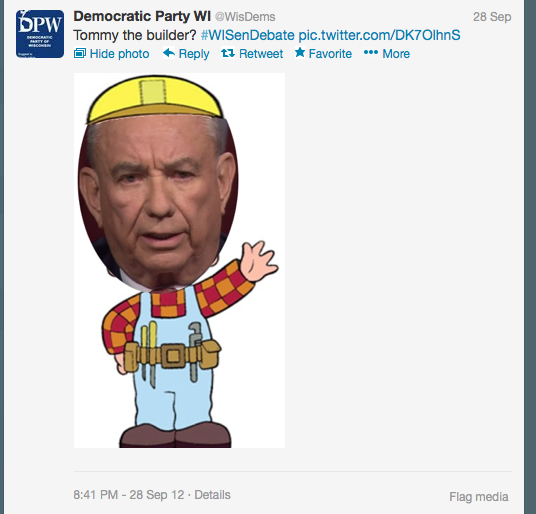
Perhaps I am naive or idealistic when it comes to my government and the people who are supposed to represent me.  For example, I was disappointed in the response by the WI Democratic Party of WI (DPW) after the first of the debates between Tammy Baldwin and Tommy Thompson.  During the debate (if one could really call it that, but that’s for a different post), Thompson referred to himself as one who helped to build Wisconsin during his time as governor.  Instead of focusing on the issues and having a mature response, here is what the DPW posted to Twitter:

Tommy the Builder DPW

For those of you who don’t know, that is Gov. Thompson’s head pasted onto Bob the Builder’s body.  That was their response.  Apparently, this is what politics has been reduced to in the United States.

On the topic of name-calling, I might be a bit old-fashioned when it comes to elected officials- you call them by their title, even if you disagree with their politics.  Name-calling has been prevalent in WI politics the past two years, with opponents of Gov. Walker resorting to names like “Scotty” and “Scooter” (a reference to his first name, Scott).  On a national level, leading up to the presidential election, we heard names like “Mittens” (for Gov. Romney) or “Barry” and “Nobama” (for Pres. Obama).

It is unfortunate that the American political system has become prone to circus-like antics (see my previous post on the Wisconsin State of the State) and childish behavior as exhibited by both the parties and its supporters.  We, the electorate, deserve better than that.  I hope that my representatives at both the state and federal level will rise above their peers and set the standards for others to emulate.

Intellectuals, Academics, and Historians, Oh My!

So, for the past two weeks, I’ve been carrying around two articles not quite knowing what to write about them.  I found both of them to be quite compelling and thought-provoking, and I knew I wanted to share them, but I just couldn’t figure out a good approach.  To be honest, I still don’t have one; nonetheless, I wanted to share my thoughts.  The two articles appeared within one day of each other- “Failure of European Intellectuals?” by Jan-Werner Müller, and “Missing Voices” by Anand Menon- and were calls for action in Europe.

Müller asks what the role of Europe’s intellectuals should be.  One topic that struck me was the role of ideas.  In the 20th century, so Müller argues, ideas mattered and “could be directly translated into politics and turn into deadly forces.”  My response to this was rather cynical, asking if ideas still matter.  In an age when money plays a larger and larger role in politics, do ideas even matter?  Would anybody listen to them?  For that matter, are the ideas espoused by politicians original ideas, or do they originate with big business?  This is where the intellectuals come into play.  They are the ones who are supposed to take all of the messages, “clarify the options,” explain the benefits and detriments,  “and then [leave] it to the peoples of Europe to decide.”  Ideally, the result would be a European population who would at least begin to understand how the EU works.

Menon’s article notes the “absence of academics” in the important debates among policymakers.  He argues that while publications in academic journals leads to success in academia, academics can and should address “pressing contemporary problems.”  This reminded me of an panel I attended at the 125th Annual Meeting of the AHA titled, “The Public Uses of History and the Global War on Terror.” Here’s what I wrote (on my school website) on Jan 10, 2011, about the panel, “Perhaps one of the biggest arguments made by many of the panelists was for historians to engage in public discourse regarding policies.  Of course, this may be easier for those at post-secondary institutions who have a greater degree of intellectual freedom than those of us at the secondary level.  The other interesting issue at stake for this panel was that of the correct use of history.  Numerous analogies have been made between the wars in Afghanistan and Iraq with previous wars, notably Vietnam and the Second World war.  Two of the panelists in particular argued that policymakers and other government officials have misused history to formulate policies.”

I think it is safe to say, then, that the public needs to hear more from intellectuals and academics when trying to make sense of political issues.  Not only would this lead to a more informed citizenry, but it would also help policymakers avoid the mistakes of the past (if they decide to listen).

Regards,

Jason

American vs European Education

In the past two weeks, Diane Ravitch, a professor of education, has written two articles in The New York Review of Books–  “Schools We Can Envy,” (March 8, 2012)  and “How, and How Not, to Improve Schools,” (March 22, 2012).  Both articles mention some of the problems plaguing America’s schools as well as ideas for solutions.  For inspiration, Ravitch points readers to look towards Finland, a country that consistently scores high in the Programme for International Student Assessment (PISA) from the OECD. As a high school teacher, her arguments resonated with me, and since I am leaving for Germany to participate in our school’s exchange, I wanted to see how Europeans view their respective education systems and more specifically, their teachers.  With that in mind, I pose the following questions for my readers in Europe and look forward to reading their thoughts.

1. How many standardized tests do students take each year and for what purpose?

2. In general, how are teachers treated?

3. What is the relationship between universities and high school (or the European equivalent)?  Does getting into the “right” university affect what is taught at high school?

4. How are the school systems set up? (Do all kids go to the same schools, or do they diverge at some point into academic and vocational schools?)

5. How do schools receive their funding? (Local, state, federal?)

6. Do schools attempt to develop collegiality among teachers?

7. What is taught in regards to European history and the EU?

Regards,

Jason