The United States and Scandinavia: A Comparison

**Note: I wrote an updated version of this in Jan 2020 to include all the Nordics. You can read it here.

During the May 3 edition of “This Week,” Sen. Bernie Sanders told George Stephanopoulos, “If we know that in countries in Scandinavia, like Denmark, Norway, Sweden, they are very democratic countries obviously; their voter turnout is a lot higher than it is in the United States.  In those countries, health care is a right of all people.  In those countries, college education, graduate school is free.  In those countries, retirement benefits, childcare are stronger than in the United States of America.  And in those countries by and large, government works for ordinary people in the middle class, rather than, as is the case right now in our country, for the billionaire class.”  Stephanopoulous responded, “I can hear the Republican attack ad right now; ‘he wants America to look more like Scandinavia’.”  Sanders was okay with that, arguing, “That’s right.  That’s right.  What’s wrong with that?  What’s wrong when you have more income and wealth equality.  What’s wrong when they have a stronger middle class in many ways than we do, a higher minimum wage than we do and they’re stronger on the environment than we are.”  Sanders went on to say that there is nothing wrong with learning to other countries.  The portion begins around 1:40 of the video clip–

It is in that spirit that I set out to compare the U.S. and Scandinavia on a number of topics, including some of those mentioned by Sen. Sanders.

GDP per capita (2013)
a) Denmark: $59,818.60; b) Norway: $100,898.40; c) Sweden: $60,380.90; d) United States: $53,042.00

Individual Income Tax Rate (2014)
a) Denmark: 55.41%; b) Norway: 47.2%; c) Sweden: 57%; d) United States: 39.6%

Unemployment Rate (2013)
a) Denmark: 7.0%; b) Norway: 3.5%; c) Sweden: 8.1%; d) United States: 7.4%

Income Inequality (Gini Coefficient- the closer to 1, the greater the inequality, 2011)
a) Denmark: .253; b) Norway: .250; c) Sweden: .273; d) United States: .389

Quality of Overall Transport Infrastructure (Rank out of 144; 2014)
a) Denmark: 15; b) Norway: 28; c) Sweden: 18; d) United States: 16

Public Investment on Infrastructure (% of GDP; 2014)
a) Denmark: 3.4%; b) Norway: 3.3%; c) Sweden: 4.5%; d) United States: 4.1%

Total Paid Leave for Mothers (in weeks; 2014)
a) Denmark: 50; b) Norway: 81; c) Sweden: 60; d) United States: 0

Paid Leave Reserved for Fathers (in weeks; 2014)
a) Denmark: 2; b) Norway: 14; c) Sweden: 10; d) United States: 0

Public Spending on Education- Primary, Secondary, and Tertiary (% of GDP, 2011)
a) Denmark: 7.0%; b) Norway: 6.2%; c) Sweden: 6.0%; d) United States: 4.9%

Public Expenditure for Childcare and Early Education (% of GDP; 2014)
a) Denmark: 2.0%; b) Norway: 1.2%; c) Sweden: 1.6%; d) United States: 0.4%

Cost of Childcare, Couples (% of average wage; 2014)
a) Denmark: 11.9%; b) Norway: 14.9%; c) Sweden: 5.8%; d) United States: 35.1%

Mean Score in PISA (2012)
a) Denmark: 500; b) Norway: 489; c) Sweden: 478; d) United States: 481

Poverty Rates for Children (2010)
a) Denmark: 3.7%; b) Norway: 5.1%; c) Sweden: 8.2%; d) United States: 21.2%

Voter Turnout (2013 or latest available year)
a) Denmark: 87.74%; b) Norway: 78.23%; c) Sweden: 84.63%; d) United States: 66.65%

Environmental Performance Index (Rank out of 178; 2014)
a) Denmark: 13; b) Norway: 10; c) Sweden: 9; d) United States: 33

Health Care Ranking (out of 11 countries, 2014)
a) Denmark: Not part of the study; b) Norway: 7; c) Sweden: 3; d) United States: 11

Life Expectancy (2014)
a) Denmark: 79.9 years; b) Norway: 81.4 years; c) Sweden: 81.9 years; d) United States: 78.7

Corruption Perceptions Index (Rank out of 175; 2014)
a) Denmark: 1; b) Norway: 5; c) Sweden: 4; d) United States: 17

Press Freedom Score (0 is the most free; 2015)
a) Denmark: 12; b) Norway: 10; c) Sweden: 10; d) United States: 22

Life Satisfaction (10 is most satisfied; 2014)
a) Denmark: 9.4; b) Norway: 9.7; c) Sweden: 8.9; d) United States: 7.5

Since Denmark, Norway, and Sweden do not have laws for a minimum wage, I did not include that data.

While the list of indicators is not exhaustive and does not give a complete picture of life in these countries, it would appear Sen. Sanders is on to something here.  The question now is- what can U.S. policymakers learn from these countries?

To learn more about the three Scandinavian countries in general, check out their embassy websites:

Thanks for reading.
Why You Should Care About US Infrastructure

Even before he announced his candidacy for President, Sen. Bernie Sanders touted a plan for America’s infrastructure.  His bill, the Rebuild America Act of 2015, would cost around $1 trillion and create and maintain 13 million jobs.  It seems like a hefty price tag, but given the fact that the infrastructure in the U.S. is crumbling, it is well worth it.

The Current State of America’s Infrastructure
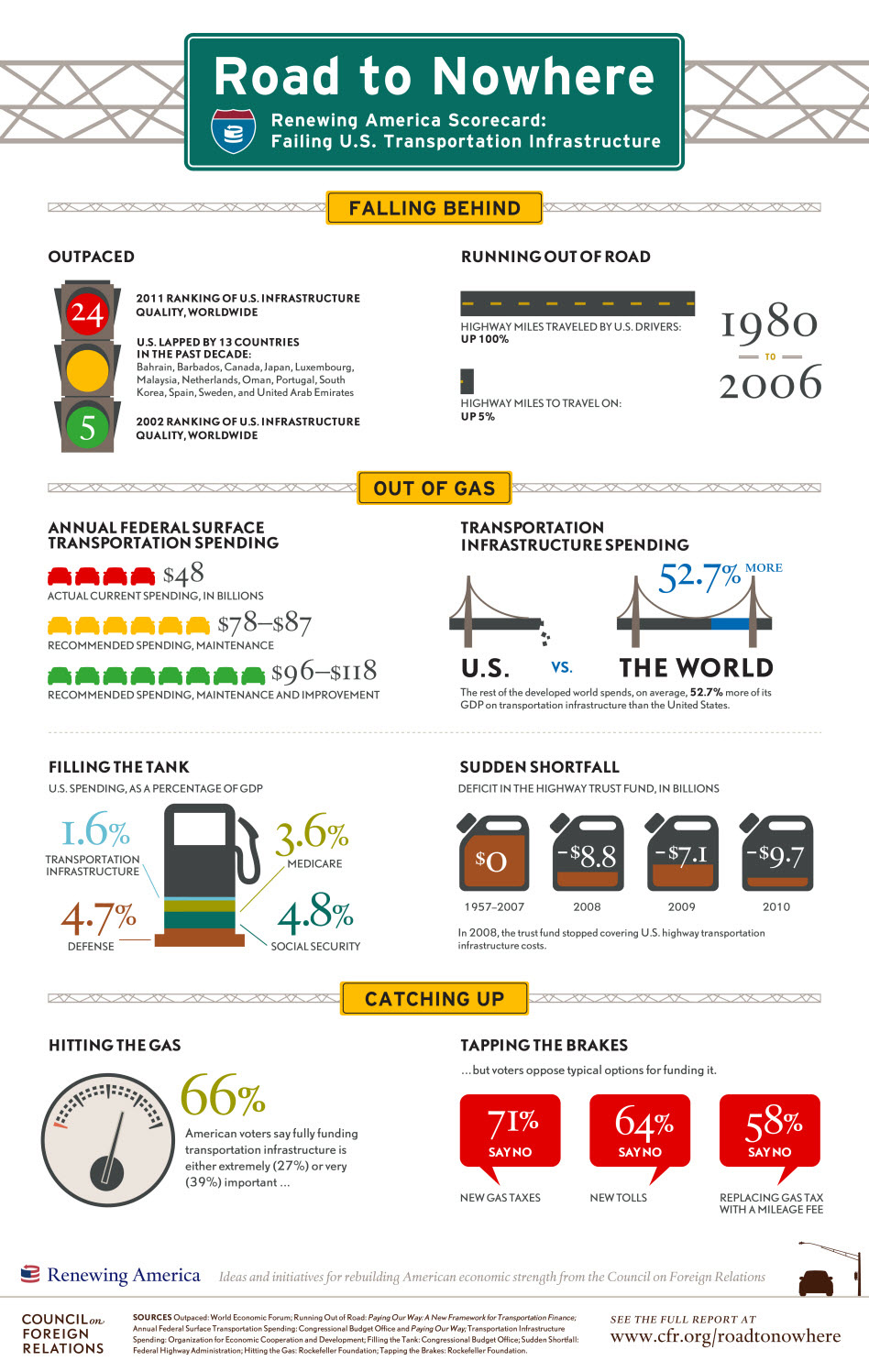
Back in June 2012, the Council on Foreign Relations released “Road to Nowhere,” a progress report on US infrastructure.  While the report is short and informative, the infographic sums up the message nicely:

Infrastructure_Scorecard_5


When we compare the U.S. with our counterparts in the OECD, the results are not good for America; however, things have improved since the report.  According to the OECD’s “2015 Going for Growth,” U.S. spending as a percent of its GDP has increased to 4.1% (the OECD average is 3.5%).  Additionally, the World Economic Forum’s Global Competitiveness Index ranked the overall quality of U.S. infrastructure  at 16th (we were 24th in 2012).  While that is illustrative of improvement here, it is surely still not what one might expect from the world’s largest economy (based on GDP).

Perhaps one of the best places to look for information on all of this is the “2013 Report Card for America’s Infrastructure” from the American Society of Civil Engineers.  While the ASCE stands to benefit from building and maintaining our infrastructure, the U.S. report card and the Wisconsin state report card are still good gauges.  Here are just a few of the pieces of information I found that highlight the need for improvement:

  • In some places, pipes and mains for drinking water are more than 100 years old (p. 5)
  • “One in nine of the nation’s bridges are rated as structurally deficient.” (p. 6)  This means that they are restricted to light vehicles, closed to traffic, or require rehabilitation.  In Wisconsin, 8.5% of the bridges fit this description.
  • Schools do not have the funding they need for construction and maintenance. In Wisconsin, schools had “$4.4 billion in infrastructure funding needs.”
  • Wisconsin has fifty-five sites on the National Priority List.  These are sites that “release or threaten the release of hazardous substances, pollutants, or contaminants.” (p. 21)
  • “32% of America’s major roads are in poor or mediocre condition, costing U.S. motorists…$67 billion a year.” (p. 21)
  • “42% of America’s major urban highways remain congested, costing the economy an estimated $101 billion in wasted time and fuel annually.” (p. 48)  The ASCE estimates the fuel lost at 1.9 billion gallons.
  • “45% of American households lack any access to transit.” (p. 51)
  • The U.S. electric grid has facilities dating back to the 1880s (p. 60, italics mine)

Funding
The main reason the U.S. has problems with its infrastructure is funding.  As noted above, spending has increased since 2012, but it is still not enough.  In their report on creating a national infrastructure bank, the Center for American Progress highlights four main problems with funding and investment:

  • Failure to provide sufficient public funds
  • Failure to attract private investment
  • Failure to coordinate investments
  • Failure to allocate funds efficiently (p. 4, NIB)

If the lack of funding is not addressed (and therefore infrastructure is not maintained), the ASCE estimates “by 2020, the economy is expected to lose almost $1 trillion in business sales, resulting in a loss of 3.5 million jobs.” (p. 5, “Failure to Act: The Impact of Current Infrastructure Investment on America’s Economic Future“)  They’ve even created a nice infographic on the topic:

Investing in Infrastructure


The U.S. government cannot keep putting off funding and investing in infrastructure.  At the current rate, the funding gap is projected to be just over $1 trillion by 2020 and almost $4.7 trillion by 2040. (p. 7, Failure to Act).

Economic Impact
If you’re still not convinced about the need for massive reform concerning U.S. infrastructure, maybe some figures on the economic impact will help.  It is important to remember that lack of funding and investment for infrastructure negatively affects “business productivity, GDP, employment, personal income, and international competitiveness.” (p. 4, Failure to Act)  In other words, crumbling infrastructure affects trade.  If trade is affected, then jobs are also affected.  If jobs are affected, personal income is affected.  Delays in shipping goods (whether on the surface, waterways, or in the air) to markets increases the cost of those goods.  If the cost of goods goes up, disposable income goes down.  At the current rate, U.S. households can expect “an average loss of more than $3,000 per year through 2020 in disposable income.” (p. 7, Failure to Act)

In 2010, 76% of U.S. exports and 70% of imports arrived via ports (p. 41, Report Card).  If the roads, rail system, and inland waterways to ports (as well as other modes of transportation) are not sufficient to handle the movement of goods, it could spell economic trouble.  Ports are an important part of the Wisconsin economy, as they handle approximately $2.4 billion in goods every year.

Screen Shot 2015-05-13 at 1.49.41 PM

Additionally, “deficient and deteriorating transit systems cost the U.S. economy $90 billion in 2010” (p. 51, Report Card).  Improving and increasing transit systems would help those without access to automobiles get to places of employment or stores.  Additionally, passenger rail helps decrease wear and tear of roads, as well as reduce congestion of roads and highways.

Undertaking a massive plan to overhaul U.S. infrastructure not only helps businesses and trade, it also helps workers.  According to a recent report from the Brookings Institution, “every $1 billion in highway spending can directly and indirectly create up to 13,000 jobs a year.”  Additionally, many infrastructure jobs have low barriers to entry, which makes it easier for workers without a four-year college degree to find employment.  Since infrastructure workers do, however, need recruiting and training, this is an opportunity for technical colleges to offer more programs.

Time to Rebuild America
It should be clear that the U.S. has a lot of work to do to improve its infrastructure.  The ASCE Report Card argues that “America’s infrastructure needs bold leadership and a compelling vision at the national level” (p. 9).  Out of the major presidential candidates who have officially announced their candidacy, only Bernie Sanders has a plan- the Rebuild America Act.  His bill calls for funds to be allocated to the following areas:

  • The Highway Trust Fund (which is about to run out of money)
  • Intercity Passenger and High-Speed Rail
  • Transportation Infrastructure Finance and Innovation
  • Airport Improvement
  • Next Generation Air Transportation System
  • National Infrastructure Investments
  • State Water Pollution Control Revolving Funds
  • State Drinking Water Treatment Revolving Loan Funds
  • Water Infrastructure Finance and Innovation
  • Non-Federal Dams and Levees
  • Inland Waterways
  • Harbor Maintenance
  • Dams and Levees
  • The National Park Service
  • The Broadband Initiatives Program
  • The Broadband Technology Opportunities Program
  • The Electric Grid

The bill also called for a National Infrastructure Bank, which would help address the problems with funding and investment I mentioned above.  I look forward to the Senator expanding on his plan in the coming months.

What are your thoughts?  Should the U.S. be worried about its infrastructure, or are the ASCE and other organizations blowing things out of proportion?  Thanks for reading.

Bernie Sanders’ Press Conference

Sen. Bernie Sanders held a press conference today to discuss the some of the big issues facing the U.S. and his ideas to address them as a presidential candidate.  It was a short conference- about ten minutes- but within that time, Sen. Sanders impressed me once more with his passion and his stances on the issues.  Here’s a quick rundown–

The economy: I really like how he described the current problem of income inequality as immoral.  He also called our current economic trajectory “unsustainable.”

Campaign finance: Billionaires should not be able to buy elections and/or candidates.  I hope that he will live up to the point that his campaign will make its money from small individual contributions via his website.  According to the National Institute on Money in State Politics, in 2012, Sen. Sanders had $4.1 million in unitemized donations (i.e. donations in the amount of less than $200).  That’s an impressive grassroots fundraising effort.

Climate change: Big goal of the U.S. leading the world away from fossil fuels, and towards energy efficiency and sustainability.

Infrastructure: To help fight unemployment in the U.S., he has a plan that would create and maintain (that’s the key) 13 million jobs.  I highly recommend looking at the 2013 Report Card for America’s Infrastructure from the American Society of Civil Engineers for more information on the current status of our crumbling infrastructure.

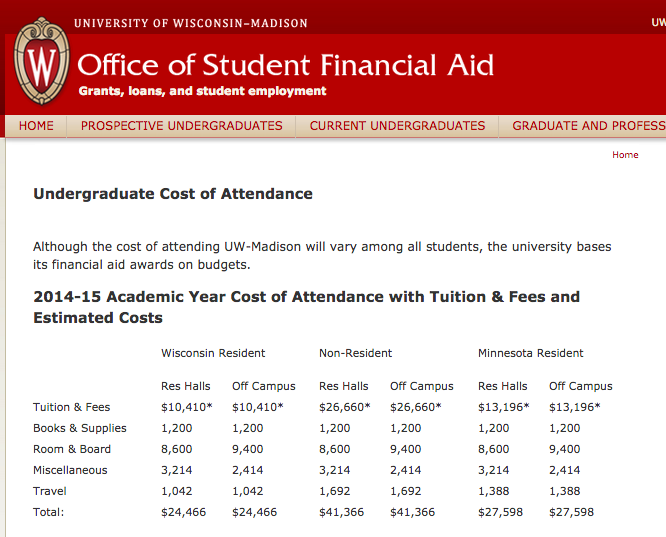
College affordability: Students are graduating college with staggering amounts of debt.  Sen. Sanders would like to make public universities tuition-free, similar to Germany.  As a result of rising tuition costs, university education has become more of a privilege than a right.  Here in Wisconsin, four years at the flagship public university, the University of Wisconsin-Madison, will cost students almost $100,000.

Screen Shot 2015-01-20 at 3.36.53 PM

Campaigns: I agree with him that we need serious debates over serious issues.  I also appreciate that he does not go negative in his campaigns.  He also emphasized that disagreement is part of democracy and that he runs “vigorous campaigns.”  After his press conference ended, Hillary Clinton’s campaign sent out a tweet welcoming Sen. Sanders to the race; he gave an excellent reply–

Screen Shot 2015-04-30 at 2.10.54 PM

Based on this press conference, and other speeches and articles, I can confidently declare that I support Sen. Sanders in his run for the presidency.

Thanks for reading.

**Thanks to J.T. Stepleton for the information on unitemized donations.

Gov. Walker’s #1 Priority

According to this tweet from Gov. Scott Walker, the most important issue that needs to be addressed above all else is border control.

Screen Shot 2015-04-09 at 5.10.36 AM

Not increasing jobs and growing the economy.  Not improving public education and reducing college tuition.  Not addressing the alarming rate of poverty.  None of those.  The problems associated with those issues are nothing compared to to border control.  This is how he plans to revive America- by securing the border?

To quote the snooty waiter from Ferris Bueller’s Day Off, “I weep for the future.”

Thanks for reading.

Educating Future Generations of Atlanticists: A Response to Tobias Bunde

I recently came across an excellent (and important) essay by Tobias Bunde titled, “Will There Be Another Generation of Atlanticists?”  In it, Bunde points out the concern felt by many that the under-40 generation do not seem to appreciate the transatlantic relationship as much as their parents’ or grandparents’ generations.  He also proposes that leaders on both sides of the Atlantic need to do more to point to the future of the transatlantic relationship and not focus as much on the past.  While politicians, economists, and other government officials are surely important for the transatlantic renaissance, we must ask ourselves how we are going to ensure future generations see the benefits and understand the special relationship.  I propose that one of the most important ways to accomplish this is through education.

At one point, Bunde argues that “just telling ourselves again and again about our glorious common history will not suffice to build the ground for a strong transatlantic partnership.”  He is correct in that if we want to move forward with Atlantic community, we cannot continually look to the past and all of its successes.  The past is important, however, if we are going to educate a future generation of Atlanticists.  It is crucial that the under-40, or for that matter the under-20 generation, understand where we came from to better understand where we might possibly go.  In this regard, I am reminded of what John Lewis Gaddis wrote in the preface to his book, The Cold War: A New History.  He said that the book was “meant chiefly… for a new generation of readers for whom the Cold War was never ‘current events.'”  If we want our youth to understand why the transatlantic relationship matters, we must first start with educating them about its past.  For many years, I taught three courses on European history- AP European History (1400-Present); Europe in the Era of Two World Wars; and The Cold War and the Collapse of Communism (in which I assigned Gaddis’ book).  If high schools offered courses like these, we would build a solid foundation for future Atlanticists.

As Bunde mentioned, however, the past alone will not suffice.  We must therefore take it upon ourselves to educate students about the present-day transatlantic community.  (Since I teach in the US, I am going to limit my discussion here to what we can do to teach about Europe and NATO.)  Since NATO is a cornerstone of the transatlantic alliance, teachers should educate their students about the basics and current missions.  The NATO website is fairly easy to navigate and even has resources called LibGuides, “web-based research guides that contain publicly available information.”  I am a bit surprised, however, that I could not find any sort of resources specifically geared towards teachers.

In addition to NATO, students in the US should learn about the EU.  The Delegation of the EU to the US has great resources for teachers.  Personally, I have used the “EU Guide for Americans” and “Europe in 12 Lessons” with my students.  If schools are within thirty miles of Washington, DC, teachers could have one of the diplomats who work at the Delegation visit their classroom.  I was fortunate enough to have Dr. Christian Burgsmüller, Counselor Head of the Energy, Transport and Environment Section, visit my class when he was in Madison for a different event.  Finally, high school students can learn about the EU and Euro by participating in the Euro Challenge.

Teachers should also encourage students to attend seminars and conferences about the transatlantic community and global issues.  Just recently, students and young professionals had the opportunity to attend the Danish Atlantic Youth Seminar.  The goal of the seminar was to “update the post-Cold War generation on current security challenges facing the Alliance and the rest of the world.”  We need seminars like that here in the US.  Additionally, students should participate in Model UN or Model EU (although the latter are usually for post-secondary students).  Being able to delve deeply into one country’s foreign policy and learn how it approaches a variety of issues, can lead to a better understanding of not only other states, but also other international organizations.

Since teachers can play a pivotal role in maintaining and strengthening the transatlantic relationship, institutions and agencies, think tanks, and embassies involved in US-European relations should give teachers an opportunity to learn about them.  Before I read Bunde’s essay, I wrote a piece titled, “Teachers and the Transatlantic Relationship,” for the German Marshall Fund Blog Competition, arguing that teachers (both from the US and Europe) should travel across the Atlantic to learn more about our friends on the “other side of the pond.”  I was extremely fortunate to have been part of a EU study trip to Brussels one summer, but at only five days, it was not long enough for me to create a lesson or unit from my experiences.  I suggest that trips should be three to four weeks in length, with teachers creating a lesson plan at the end of each week based on their experiences.  Let’s say a group of twenty-five teachers goes to Brussels for three weeks.  At the end of that trip, those teachers would have created a combined total of seventy-five lesson plans on various aspects of Europe.  Those teachers will go back and teach many, many students each year about the transatlantic community, thereby educating a future generation of Atlanticists.

I agree with Bunde and others over their concerns regarding the future of the transatlantic relationship.  I also agree with Hillary Clinton when she wrote in her book, Hard Choices, that “For America, our alliance with Europe is worth more than gold.”  We just need to convince our youth why it is so valuable.  Finally, NATO Secretary General Anders Fogh Rasmussen said recently that we need to “deepen our personal and cultural links.”  We can accomplish this by educating our students about the transatlantic relationship and by increasing the amount of teacher exchanges.

Thanks for reading.

Follow up note, July 15, 2014: I neglected to mention that I learned about Tobias Bunde’s essay via a tweet from Joerg Wolf, editor-in-chief of Atlantic Community.