The Things I Carry

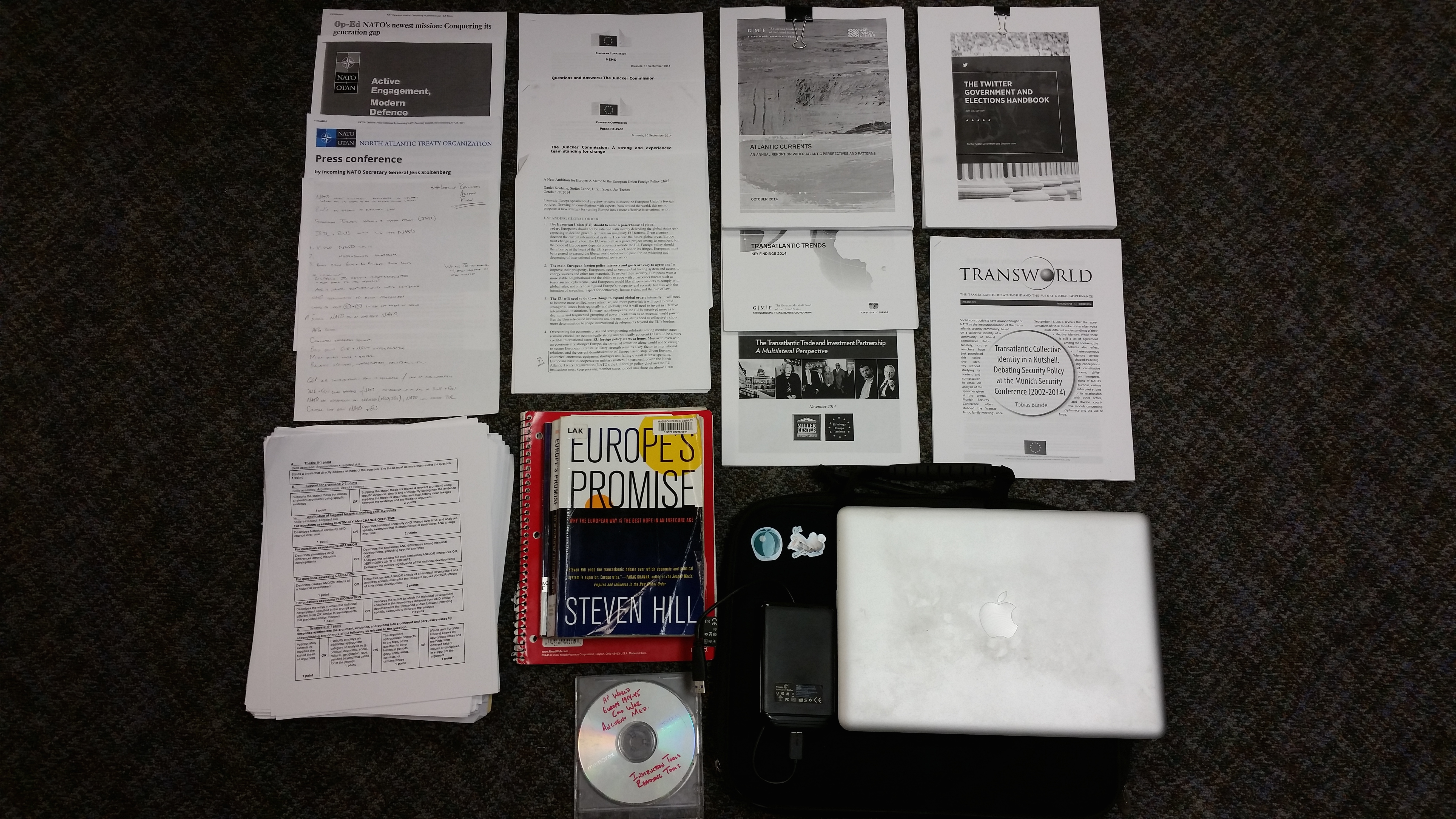
When I left work for home this past Friday, it seemed to me that my backpack was heavier than usual.  As I pulled out the papers and books, I thought of Foreign Policy magazine’s feature titled “The Things They Carried” in which they interview somebody and explore the contents of their backpack/briefcase.  I thought doing something similar would give readers an insight into how my mind works.  This is the result.
The Things I Carry

Starting with the four papers in the upper left corner, I’ve got materials on NATO.  When NATO Secretary General Jens Stoltenberg gave his first press conference, it happened to be during my Government & Politics class.  I thought it would be a great opportunity for my students to watch the conference and discuss it afterwards, so what you see on top is the paper on which I took my notes.  Underneath the transcript of the conference (which I printed off because I wanted to go back over it thinking I might write about it) are NATO’s Strategic Concept and an article by Franklin Miller and Kori Schake titled, “NATO’s newest mission: Conquering its generation gap.”

To the right of my “NATO pile” is my “EU pile,” consisting of “A New Ambition for Europe: A Memo to the European Union Foreign Policy Chief,” and two documents from the European Commission on the new Juncker Commission.  I highly recommend the memo by Daniel Keohane, Stefan Lehne, Ulrich Speck, and Jan Techau, for anybody interested in the EU’s foreign policy.  The other two documents, “The Juncker Commission: A strong and experienced team standing for change,” and “Questions and Answers: The Juncker Commission,” were useful as I watched the changes taking place in Brussels.  For reasons I cannot explain, I find the EU (its history, institutions, foreign policy, etc.) to be extremely fascinating.  As such, I am constantly learning as much as I can about it.

To the right of the “EU pile” is a stack of three reports relating to transatlantic relations- Atlantic Currents: An Annual Report on Wider Perspectives and PatternsTransatlantic Trends: Key Findings, 2014; and The Transatlantic Trade and Investment Partnership: A Multilateral Perspective.  The first two reports come from the German Marshall Fund, a think tank devoted to strengthening transatlantic cooperation.  Out of the numerous think tanks whose websites I regularly visit, I find the GMF to be the most useful and enlightening.  If you are interested in transatlantic relations, you should definitely check them out.  The report on TTIP was just released, and given the importance of trade to the transatlantic relationship, I thought it would be wise to read it.

To the right of that stack is The Twitter Government and Elections Handbook.  Given my interest in how politicians, policymakers, and diplomats use Twitter, I wanted to make sure I had a copy of this.  It’s a fascinating insight into how Twitter thinks politicians and candidates for office should use Twitter.  It starts out with the basics of setting up an account and eventually gets into topics like engaging and mobilizing followers.  I’ve been trying to think of ways to bring this into my Government & Politics class but haven’t quite nailed down what I want to share.

Underneath that is a great article by Tobias Bunde titled, “Transatlantic Collective Identity in a Nutshell: Debating Security Policy at the Munich Security Conference.”  This is the one paper I haven’t gotten to yet; however, knowing Bunde’s work on transatlantic relations (e.g. @FutureNATO and his essay on future generations of Atlanticists), I’m sure it will be worthwhile and useful.

Underneath that, in the lower right corner is my trusty, school-issued MacBook.  All of my lesson plans, tests, and other school work is on this glorious machine.  Next to it is my external drive, which I found out to be extremely valuable after all of the files for one of my classes mysteriously disappeared.  The protective sleeve is usually home to a few stickers courtesy of my children.  In the past it has been home to Bucky Badger, but now Olaf the Snowman graces the cover.  I also have CD’s with materials from courses I no longer teach just in case I want to use a lesson for a current course.

To the left of that is the book Europe’s Promise: Why the European Way is the Best Hope in an Insecure Age, by Steven Hill.  Any time I read a non-fiction book, I have to take notes, hence the notebook underneath.  Call it a bizarre quirk, but it’s important to me to jot down my thoughts and ideas/passages I want to remember.  I chose this book in particular because I recently picked up a copy of Lessons from Europe? What Americans Can Learn from European Public Policies, edited by R. Daniel Kelemen, and I wanted to read the Hill book first.  I think the U.S. has a lot to learn from European policies, but that’s for a future post.

The last pile in the lower left corner consist of four different assignments that need to be graded.  All of them are either essays or short-answers.  I try to do all school work at school (which is why I usually arrive two hours early), but I wanted to get as much done as possible before Thanksgiving break.

I know this may have seemed like a silly exercise, but I rarely share anything personal, and I thought this was a good way of doing so.  Maybe it gave you insight into the way my mind works, or maybe it showed you that I need to clean out my backpack more often.  Either way, one thing should be quite clear- I am passionate about transatlantic relations, and I hope to one day use that passion to maintain and strengthen them.

Thanks for reading.
Increasing Youth Voter Turnout in the US and Europe

I just came across a campaign in Europe designed to increase voter turnout for the May elections.  It’s called Happy Voting, and they have begun their campaign with a video of people lip dubbing to Pharrell Williams’ song, “Happy.”  Check it out–

After watching it, I wanted to see if anybody here in the US made anything similar for the 2012 presidential election.  The closest I found came from Rock the Vote.

Is there one video that makes you want to vote more than the other?  Either way, I think that the purpose of both organizations is worthwhile, and I hope that they both have success in increasing youth voter turnout.

Thanks for reading.

The Enlarged EU

I recently came across a video from 2004 about the then impending enlargement of the EU, and I wanted to share some quick thoughts.  Even though the video is fairly short, I picked up on three main ideas: the role of historical memory, the importance of the meaning of words, and the future of Europe.

For Eastern European countries, overcoming the “legacies of the past” (as the narrator put it) was crucial for membership in the EU.  They had to adopt political and economic systems very different from those under communist rule- democracy and capitalism.  The impact of communist rule was also evident when Lech Walesa mentioned, “the stronger countries shouldn’t just force the weaker ones to step back.”  Not only does that statement apply to the way the Soviet Union approached its satellites in Eastern Europe, but it could also be seen as foreshadowing and the way the recipients of bailout funds perceive the Eurozone crisis.

As for the meaning of words, I could not help but notice the word choice of Romano Prodi and Javier Solana during their respective discussions of the enlargement.  Prodi talked about the “unification” of Europe, whereas Solana discussed the “reunification” of Europe (italics mine).  Those two words, while similar in meaning, have very different connotations.  Unification implies that Europe was not united before the communist takeover of Eastern Europe after the Second World War; however, reunification leads one to believe that Europe was somehow united before that time.  Historically speaking, I would use the term “unification,” since nationalism, imperialism, and militarism divided Europe and led to the era of two world wars.  Historians have made a similar argument concerning Germany after the fall of the Wall- should it be the “unification” of Germany, or the “reunification”?

The future of Europe was also a central point of discussion during the video.   The narrator pointed out that with the enlargement, the EU was becoming the largest market in the world.  Again, I see this as foreshadowing, given the importance of transatlantic trade and the current negotiations over TTIP.  Additionally, both Prodi and Solana brought up the question of Europe’s borders and the frontier of Europe.  If Iceland and the other Balkan states eventually become members of the EU, and Turkey’s accession process continues to drag on, can there be any further talk of enlargement?  Where does the EU go from there?

Finally, if you are interested in the Eastern Enlargement, you might want to check out Europe Undivided: Democracy, Leverage, and Integration after Communism, by Milada Anna Vachudova.  I read it a few years back for a class I took about the EU and it still remains one of my favorite books about the above topics.

Thanks for reading.

What Europe and the EU Mean to One American

**Before you read this post, please keep in mind that I am an American and that what I know of Europe is based on knowledge gained from: 1) teaching European history, 2) studying it for both of my degrees, as well as continuing education courses, and 3) reading the news, books, and other blogs about Europe and transatlantic issues.  Despite my attempts to learn what I can about the EU, however, I still don’t quite have a grasp on the the intricacies of its institutions and have many questions.  What that means is that I have an outsider’s view and don’t get a chance to experience the issues (political, economic, social, etc.) that Europeans face on a daily basis.  I can only write, therefore, from my perspective from here in America.

The idea for this post started when I read an editorial in the New York Times by Daniel Cohn-Bendit and Felix Marquardt titled “The Fix for Europe: People Power,” which in turn led me to learn of a movement in Europe called Europeans Now.  The premise of the piece by Cohn-Bendit and Marquardt was that if European integration was to continue and succeed, the solutions to Europe’s problems needed to be transnational.  The idea of the need for transnational solutions struck a particular chord with me, since I am a fervent supporter of the transatlantic relationship and hope that the US and Europe maintain their historic friendship, despite “pivots” from the US towards other areas.  I also believe that as our world continues the process of globalization, governments (and their citizens) need to move away from competition and towards cooperation.

Naturally, I was curious about Europeans Now and checked out their website.  The way they describe the movement is this: “a transnational, inter-generational, non-ideological and progressive European non-profit movement that aims to take European integration to the next level.”  Additionally, with the rise of the far right in recent years I was also impressed with their message of “putting the far right movements back in their box.”  Seeing an opportunity to start a transatlantic dialogue about transnational solutions (after all, the US and the EU share similar problems), I decided to email them asking that even though I was an American, was there anything that I could do to help and be involved.  In their response (which I was surprised to receive), they asked if I was interested in making a video of myself “explaining what Europe is for you, why you support the movement, etc.”  Not being the most photogenic person in the world, I decided to write a response instead.

Europe is part of who I am. 

I am a proud German-American.  When I was fifteen years old, I researched my family history and was able to trace relatives to 18th-century Prussia.  I took German classes through high school.  When I was stationed in South Korea, I requested to be stationed in Germany after my yearlong tour was done, even though it meant that I would be away from home for a total of three years (it actually turned out to be three-and-a-half years).  While I was there (Nov 1995 – May 1998), I was stationed in Wackernheim, close to Mainz.  I was able to see Gutenberg’s Bible, the Brandenburg Gate, beautiful churches and other buildings hundreds of years old, Roman ruins in Trier, eat Currywurst mit Pommes, and even travel to the Netherlands.

Fourteen years later (2012), I traveled to Niederbiel during a two-week school exchange.  This time was much different because I was educated and had taught European history for nine years.  I gained a much greater appreciation for the history and culture of both Germany and Europe.  So when I saw what used to be a checkpoint between the former BRD and DDR, not only did I think about how Germany had been reunited, but also how Europe had been somewhat reunited after the Eastern Enlargement.  At the Haus der Geschichte der Bundesrepublik Deutschland in Bonn, I saw relics of the Nazi period and the GDR, but I also saw a copy of the treaty establishing the European Economic Community.  All I could think of when I saw that was that despite their troubled past, Europeans (or perhaps more precisely their leaders?) thought about cooperating to prevent that from happening again.  They were willing to look beyond their differences and work to build a better Europe for future generations.

Europe is a success story.

Every once in a while, I read or hear something to the effect that Europe does not have a common history.  I am always surprised at this, since through my eyes, it does share a past.  A successful past, one to be envied by others.  Think about the ideas that came out of the Scientific Revolution or the Enlightenment.  What about the so-called “Long Nineteenth Century”?  The spread of “isms” like classical liberalism, romanticism, feminism, nationalism, and even conservatism.  Of course Europe also shared the experience of an era of world wars, but surely these are all European moments and do not belong to one country.

Whatever reasons one might want to give for the establishment of the ECSC (military, economic, etc.) the EU has thus far been a success.  It succeeded in preventing war and aided in the reconstruction of Europe in the years following 1945.  I think that the EU has definitely moved in the right direction, and I am reminded of José Manuel Barroso’s response during a press conference a few years back.  When asked what the European Union would be when the treaty had been concluded, Barroso responds that the EU has “free countries that are united, and that they have decided to work together with some degree of cooperation or even integration, that is what we are.”  He goes on to say that “we are adding value to what we do at the national level.  It’s of course obvious today that the national dimension is not enough.  It’s a question of common sense.  If you want to fight climate change, if you want to provide energy security, we cannot do it alone at the national level, we need more than that, we need a European dimension…the more globalization goes, and it’s quite obvious that it’s there to stay, we need that dimension more.”  In other words, the issues that countries face today transcend national boundaries (and even regional boundaries); therefore, it it is quite logical to pool resources (financial, scientific, intellectual, etc.) to solve these problems together.  Of course, Barroso goes on to call the EU a “non-imperial empire,” which may have ruffled a few feathers, but that’s for a different post.

Is the EU perfect?  No, it seems that there is still work to be done (i.e. the CFSP, the notion of the democratic deficit, etc.), but when one looks at where Europe was in 1945 and compare it to now, I see Europe and the EU as a success story.

Thanks for reading.

My Experience in Brussels with Public Diplomacy

A few weeks ago I wrote about Sen. Russ Feingold’s book and public diplomacy.  It only hit me today that I I’ve already engaged in a form of public diplomacy, back in 2011, when I traveled to Brussels with a group of American professionals.  What follows is my reflection written for the UW-Madison EU Center of Excellence upon my return to the US.

During the week of June 20, 2011, I had the opportunity to travel to Brussels learn about the European Union and EU-US relations.  Given the fairly recent adoption of the Lisbon Treaty in 2009, as well as the prominence of the Eurozone crisis, we were there at a time of not only transition, but also of extreme importance for the EU.

Our first stop was the European Commission, where we were given a general introduction to the EU and its institutions.  One of the ideas that our contact presented to us was to equate the EU with the concept of the glass being half full versus half empty.  Given the problems plaguing the EU- the notion of a democratic deficit, the problems with the Eurozone, foreign and defense policy, etc.- many critics see the EU as an experiment gone wrong.  The other view, however, is to examine the EU through an historical lens.  If we see how far Europe has come since the first half of the twentieth century, then the EU is an experiment that has succeeded.

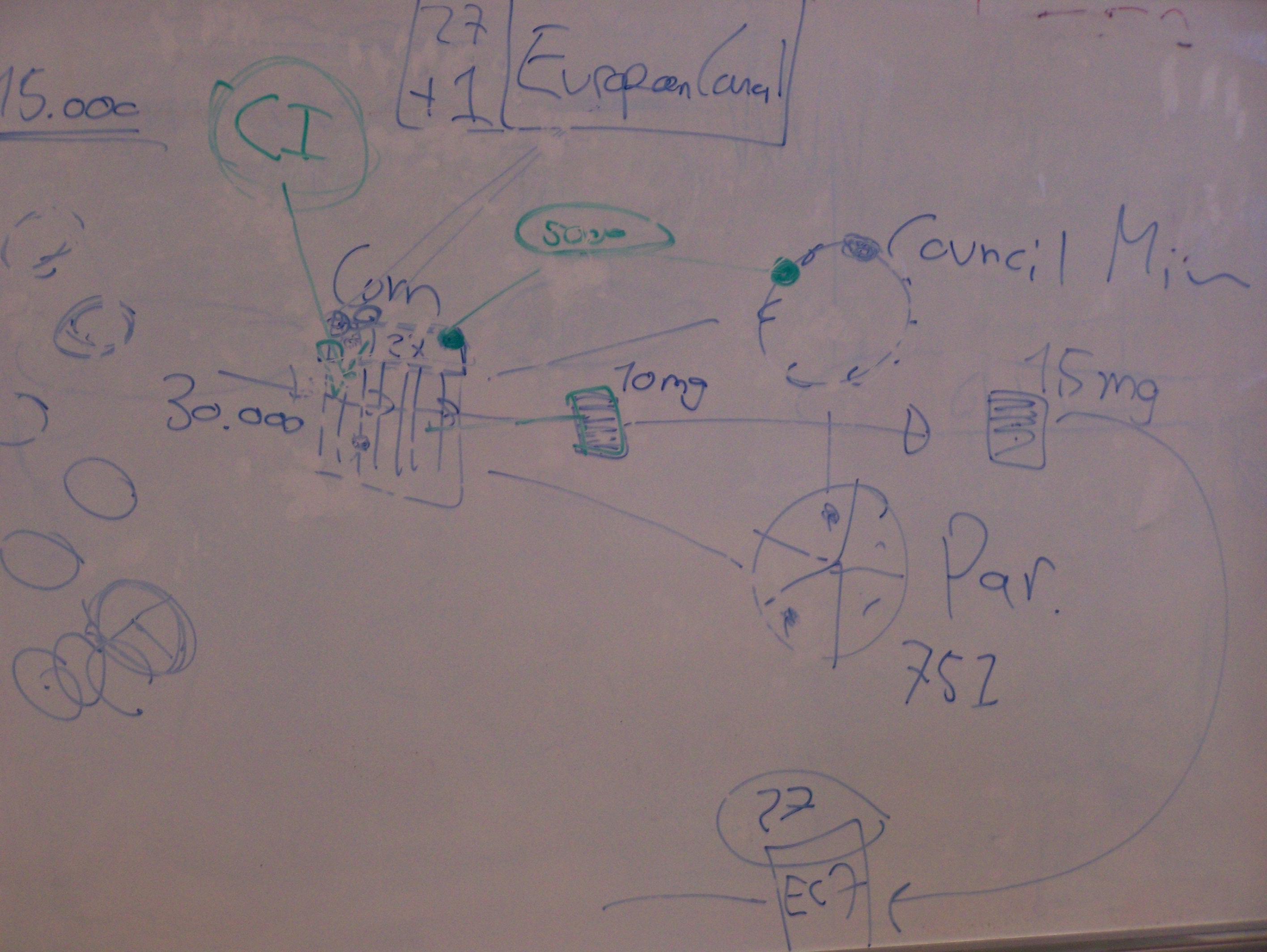
Part of our presenter's diagram explaining the EU.
Part of our presenter’s diagram explaining the EU.

One of the ways in which the EU is trying to reach out to the citizens of the Member States is disseminating information.  Since the EU is not thoroughly taught in European schools, the EU has numerous means for people to find out about it.  While the EU’s website is the best place to go for information ranging from basic information, policy areas, and the institutions themselves, it is immense and can be quite confusing.  As a result, the EU has several information offices where visitors can pick up a plethora of pamphlets and posters in a variety of languages.

While the entire trip was about learning about the EU, we also had three different opportunities to learn about EU-US relations; one such place was the US Mission to the EU.  I was quite surprised to learn that when the EU holds talks about enlargement, the US is invited to some of them.  This is especially evident with the issue of Turkey.  That same day, we had three presentations by members of the newly created European External Action Service.  All three presenters were members of the US and Canada Unit.  Our first briefing was about general EU-US relations.  Given the special relationship between the US and Europe that developed over the course of the twentieth century, the current relationship between the EU and the US is of extreme importance.  This can be seen in trade relations between the two sides, the subject of our second briefing.  Our final briefing by the EEAS covered energy and environment issues, two issues with which both sides have problems, especially dependency on foreign supplies of energy.  Our final briefing of the trip concerning EU-US relations took place at NATO headquarters.  Here we learned about the different perspectives that both the EU and US bring to the table concerning NATO issues.

100_7366

Besides the chance to see Brussels, perhaps the highlight of our trip was our experience at the European Parliament.  While our session at the EP was planned, what we saw there was not.  Due to the Eurozone crisis, the EP had called a plenary session for the day we visited.  Not only did we get to see the outgoing Hungarian President of the Council of the European Union give her farewell speech, but we also got to see the President of the European Commission, José Manuel Barroso, speak about the Eurozone crisis.  Needless to say, we were all excited that we got to see both officials speak.

All in all, this trip was a success.  The EU is a fascinating experiment in cooperation and integration, and as an educator, I hope to bring a lot of this information back to my classroom and add it to what I already teach about the EU.  Additionally, I hope that I can begin forging transatlantic relationships of my own to bridge the gap between Americans and Europeans.  Finally, I urge my fellow educators to take advantage of the workshops and other opportunities offered by the UW-Madison EU Center of Excellence and to check out the websites of both the European Union and the EU Delegation to the USA.

**Follow-up comment from August 20, 2013: Since my trip I have continued my interest in the EU and transatlantic relations. Some day I hope to go back to Brussels and even other European cities to spend more time learning about the EU and building transatlantic relationships, especially with educators.  If you happen to know of a program designed for Americans to engage with European professionals (policymakers, journalists, educators, etc.) for any length of time, please let me know.  Thanks.