Lessons from Europe: Political Gatherings

For the second post in my series, “Lessons from Europe,” I want to discuss the political gatherings in Sweden and Denmark- Almedalen and Folkemødet.  These two showcase what politics and democracy should be about, and they should be copied by states here in the U.S.

Almedalen and Folkemødet
Almedalen and Folkemødet are week-long gatherings for political parties, politicians, journalists, NGOs, non-profits, citizens, and more.  Almedalen has been running for over forty years and actually inspired Denmark to start Folkemødet.  The Swedish gathering is eight days and is organized by the parliamentary parties.  In 2014 it had over 3,500 seminars/panels in its program with topics ranging from foreign policy to healthcare to transportation policy.  In addition to the daily seminars, “the leaders from each of Sweden’s 8 political parties hold speeches every night. They use it as a opportunity to focus their party’s message, put forth new policies or take potshots at their opponents.” (Radio Sweden, “What is Almedalen?“)  Even the Prime Minister, Stefan Löfven, spoke at the gathering.

The Folkemødet characterizes its gathering as “a meeting of people and politicians, where Bornholm provides the venue for Danish politicians to debate current political issues.”  This year the gathering was held for five days and included over 2,700 seminars/panels, with “767 parties, organizations and companies participating as organizers of events.” (2015 Organizers)  This year, the U.S. ambassador to Denmark, Rufus Gifford, participated in a panel on TTIP.  In fact, the tweet below is how I learned about Folkemødet (and then Almedalen).
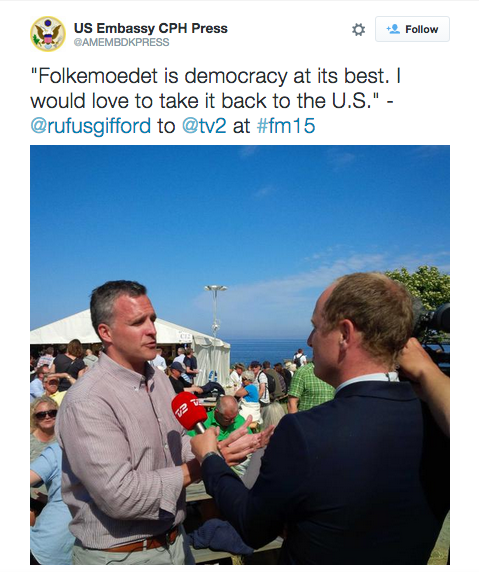
Tweet from @AMEMBDKPRESS https://twitter.com/AMEMBDKPRESS/status/609362229490749440
Tweet from @AMEMBDKPRESS
https://twitter.com/AMEMBDKPRESS/status/609362229490749440

Lesson
The lessons for the U.S. is that we need to have gatherings like Almedalen and Folkemødet in each of the states.  Here in Wisconsin, the two main political parties hold annual conventions over the course of a weekend.  When you’re limiting the voices heard to those of one party, that’s not really the foundation for substantial, vigorous discussion.  I attended one convention, and it was certainly energizing for members of the party, but that was about it.

Given the increasing cynicism of the American electorate towards our two-party system, we should strive to hold week-long gatherings with voices from all state parties.  In Wisconsin, that means including the Libertarian Party, Green Party, and the Constitution Party.  Additionally, we should also hear from the hundreds of non-profits and journalists in the state.  The more voices that participate and are heard, the better for our system.

While it would be great to have such a gathering, I have to wonder if it is even possible in our current political climate.  Polarization has increased over the years, and hateful, ignorant rhetoric makes civilized political discussions rare.  Can Americans move beyond that and hold a gathering like those in Sweden or Denmark?  If not, then what does that say about our future?

Thanks for reading.


Lessons from Europe: Civic Engagement

This is the first post in a new series I am trying out, “Lessons from Europe,” and I wanted to begin with a topic that it is very important to me- civic engagement.  It is essential for the future of democracy to have youth involved in the process.  They should understand the political systems and policymaking processes where they live, and they should have their voices heard by our elected leaders and government officials.  This point is reinforced by Article 12 of the Convention on the Rights of the Child, which states the following-

“1. States Parties shall assure to the child who is capable of forming his or her own views the right to express those views freely in all matters affecting the child, the views of the child being given due weight in accordance with the age and maturity of the child.

2. For this purpose, the child shall in particular be provided the opportunity to be heard in any judicial and administrative proceedings affecting the child, either directly, or through a representative or an appropriate body, in a manner consistent with the procedural rules of national law.”

I found two great examples of youth involvement in the political process in Europe- Children’s Parliaments and the European Youth Event.

Children’s Parliaments
In his book, Europe’s Promise, Steven Hill talks about the Children’s Parliaments in Germany.  These bodies are composed of school-aged children and meet throughout the year.  Hill writes that they “convene and debate issues and are actually permitted to propose legislation to the local city council.” (p. 243, italics in original)

In Finland, students 15-16 years old have the opportunity to participate in the Youth Parliament.  According to the brochure the Embassy of Finland sent me, “Its objective is to promote social participation and integration among young people and foster interest in social affairs in general and Parliament in particular.”  The brochure makes the point that one of the most important pieces of participating in the Youth Parliament is contacting MP’s and local government officials.

European Youth Event
In addition to the Children’s Parliaments, I also found something called the European Youth Event.  The EYE was a three-day event organized by the European Parliament and other agencies.  During the event thousands of Europeans ages 16-30 discussed a variety of topics pertinent to Europe.  According to the report, “The core aim of the European Youth Event was to demonstrate that young people are willing to engage in developing a brighter future for a more prosperous, inclusive, innovative, and sustainable European Union, and that they are an invaluable source for ideas on how to achieve this.”  (p.9, italics mine)  After the EYE finished, the final report was given to MEP’s, and some of the participants were allowed to present ideas to MEP’s themselves.  I think its great that one of the main institutions of the EU, along with other bodies, see the importance of youth participating in the political process and organize an event such as the EYE.

Lesson
The biggest lesson here is that while youth in the US are allowed to speak at local meetings (especially school board meetings) and write to their elected officials, our local/state governments do not organize anything like the Children’s Parliaments or EYE.  We have simulations like Model UN or, in the case of Wisconsin, Badger Girls and Badger Boys, but they are just simulations.  To really make them more beneficial to participants, they should be able to present their work to elected officials or policymakers and take their discussions “to the next level.”  Why don’t we have an American Youth Congress that gathers in Washington, DC, for three or four days, discussing issues and presenting ideas for solutions to members of Congress and other officials?  Surely, we could have something like that at the state level.  The key though, is that like the Children’s Parliament and EYE, our actual legislatures must be involved in organizing them and promoting them.  Our elected officials must see American youth as invaluable as well.

The other lesson is more of a broader issue- the US has not ratified the Convention on the Rights of the Child.  We signed it (five years after it entered into force), but we have not ratified it.  Why is that?  What are waiting on?

In my next post, I will continue this theme of political participation and discuss the political festivals in Sweden (Almedalen) and Denmark (Folkemødet.)

Thanks for reading.

New Series: Lessons from Europe

This past year, I read Steven Hill’s Europe’s Promise: Why the European Way is the Best Hope in an Insecure Age.  As I went through it, I took notes of some of the more interesting ideas that I would like to see adapted here in the U.S.  Since I have not written anything on the blog about Europe for a while, I thought this would be a good time to start a new series called “Lessons from Europe,” during which I bring up some of those interesting ideas and discuss the possibilities for the United States.

Here’s what I’m thinking as far as possible topics go:

1) Civic engagement

2) Family values (focusing more on early childhood)

3) Environmental policy

4) Public transportation

5) If I’m feeling particularly ambitious- political systems (specifically campaigns and representation)

If I focus and work diligently every day, I could have the first four done before I go back to school in late August.  Of course, it is summer break, so that may not happen.

For my European readers (if there are any)- if you think you’ve got a good thing going where you are, some sort of policy or way of doing things that you think we Americans can learn from, please feel fee to leave a comment below.

Thanks for reading.

**I would like to thank my former colleague Kris Cody-Johnson, English teacher extraordinaire, for the inspiration to attempt this series.  She recently launched a similar project focusing on the Wisconsin Idea.

The United States and Scandinavia: A Comparison

**Note: I wrote an updated version of this in Jan 2020 to include all the Nordics. You can read it here.

During the May 3 edition of “This Week,” Sen. Bernie Sanders told George Stephanopoulos, “If we know that in countries in Scandinavia, like Denmark, Norway, Sweden, they are very democratic countries obviously; their voter turnout is a lot higher than it is in the United States.  In those countries, health care is a right of all people.  In those countries, college education, graduate school is free.  In those countries, retirement benefits, childcare are stronger than in the United States of America.  And in those countries by and large, government works for ordinary people in the middle class, rather than, as is the case right now in our country, for the billionaire class.”  Stephanopoulous responded, “I can hear the Republican attack ad right now; ‘he wants America to look more like Scandinavia’.”  Sanders was okay with that, arguing, “That’s right.  That’s right.  What’s wrong with that?  What’s wrong when you have more income and wealth equality.  What’s wrong when they have a stronger middle class in many ways than we do, a higher minimum wage than we do and they’re stronger on the environment than we are.”  Sanders went on to say that there is nothing wrong with learning to other countries.  The portion begins around 1:40 of the video clip–

It is in that spirit that I set out to compare the U.S. and Scandinavia on a number of topics, including some of those mentioned by Sen. Sanders.

GDP per capita (2013)
a) Denmark: $59,818.60; b) Norway: $100,898.40; c) Sweden: $60,380.90; d) United States: $53,042.00

Individual Income Tax Rate (2014)
a) Denmark: 55.41%; b) Norway: 47.2%; c) Sweden: 57%; d) United States: 39.6%

Unemployment Rate (2013)
a) Denmark: 7.0%; b) Norway: 3.5%; c) Sweden: 8.1%; d) United States: 7.4%

Income Inequality (Gini Coefficient- the closer to 1, the greater the inequality, 2011)
a) Denmark: .253; b) Norway: .250; c) Sweden: .273; d) United States: .389

Quality of Overall Transport Infrastructure (Rank out of 144; 2014)
a) Denmark: 15; b) Norway: 28; c) Sweden: 18; d) United States: 16

Public Investment on Infrastructure (% of GDP; 2014)
a) Denmark: 3.4%; b) Norway: 3.3%; c) Sweden: 4.5%; d) United States: 4.1%

Total Paid Leave for Mothers (in weeks; 2014)
a) Denmark: 50; b) Norway: 81; c) Sweden: 60; d) United States: 0

Paid Leave Reserved for Fathers (in weeks; 2014)
a) Denmark: 2; b) Norway: 14; c) Sweden: 10; d) United States: 0

Public Spending on Education- Primary, Secondary, and Tertiary (% of GDP, 2011)
a) Denmark: 7.0%; b) Norway: 6.2%; c) Sweden: 6.0%; d) United States: 4.9%

Public Expenditure for Childcare and Early Education (% of GDP; 2014)
a) Denmark: 2.0%; b) Norway: 1.2%; c) Sweden: 1.6%; d) United States: 0.4%

Cost of Childcare, Couples (% of average wage; 2014)
a) Denmark: 11.9%; b) Norway: 14.9%; c) Sweden: 5.8%; d) United States: 35.1%

Mean Score in PISA (2012)
a) Denmark: 500; b) Norway: 489; c) Sweden: 478; d) United States: 481

Poverty Rates for Children (2010)
a) Denmark: 3.7%; b) Norway: 5.1%; c) Sweden: 8.2%; d) United States: 21.2%

Voter Turnout (2013 or latest available year)
a) Denmark: 87.74%; b) Norway: 78.23%; c) Sweden: 84.63%; d) United States: 66.65%

Environmental Performance Index (Rank out of 178; 2014)
a) Denmark: 13; b) Norway: 10; c) Sweden: 9; d) United States: 33

Health Care Ranking (out of 11 countries, 2014)
a) Denmark: Not part of the study; b) Norway: 7; c) Sweden: 3; d) United States: 11

Life Expectancy (2014)
a) Denmark: 79.9 years; b) Norway: 81.4 years; c) Sweden: 81.9 years; d) United States: 78.7

Corruption Perceptions Index (Rank out of 175; 2014)
a) Denmark: 1; b) Norway: 5; c) Sweden: 4; d) United States: 17

Press Freedom Score (0 is the most free; 2015)
a) Denmark: 12; b) Norway: 10; c) Sweden: 10; d) United States: 22

Life Satisfaction (10 is most satisfied; 2014)
a) Denmark: 9.4; b) Norway: 9.7; c) Sweden: 8.9; d) United States: 7.5

Since Denmark, Norway, and Sweden do not have laws for a minimum wage, I did not include that data.

While the list of indicators is not exhaustive and does not give a complete picture of life in these countries, it would appear Sen. Sanders is on to something here.  The question now is- what can U.S. policymakers learn from these countries?

To learn more about the three Scandinavian countries in general, check out their embassy websites:

Thanks for reading.

Thoughts on the UK Parliamentary General Election

My first exposure to the UK Parliamentary General Election was in 2010.  That year, I showed one of the leaders debates to my classes to have them compare it with our presidential debates.  This year, I showed the first leaders debate (April 2) to one of my classes, again for the same purpose.  While I followed the 2010 election out of my interest in European politics, I have followed the 2015 election a bit more closely, as I will be teaching about the UK in a new class next year.  As I strive to get a better understanding of the electoral process, I wanted to share some thoughts I’ve had since that first debate.

First, I am surprised at the brevity of the campaign.  Thanks to Giles Goodall, a candidate for the LibDems, I learned that there is a short campaign (which starts when Parliament is dissolved) and a long campaign (which began back in December).  This handout from the UK Electoral Commission explained it nicely.  Compared with the U.S., this is a short time for campaigning;  even our campaigns for the House of Representatives last longer.  I wonder what Britons make of the length of our presidential campaigns.

Second, campaign finance is much different there than here in the U.S.  To see how much they are limited to, I’ll refer you to the aforementioned handout form the Electoral Commission.  During the long campaign, a candidate is limited to a fixed amount of £30,700 plus a variable amount of 6p/9p (100p in a British pound) per elector in a borough/county constituency.  In U.S. dollars, that’s a fixed amount of $46,565.76.  The variable amount is based on the number of electors in the constituency.  According to the Electoral Statistics for UK, 2014, “The typical size of constituencies differs between the constituent countries of the UK with a median total parliamentary electorate across constituencies of about 71,000 in England, 68,900 in Scotland, 67,500 in Northern Ireland and 55,100 in Wales.”  So, if I am a candidate in England, using the median, my variable amount for a borough would be just over $6700 (British readers, please correct me if I am incorrect, my knowledge of the British Pound is minimal, thanks).  That means that I would be able to spend just over $53,000 from December 19, 2014, through March 30, 2015 (the earliest start of a short campaign).  The amount for the short campaign, which lasts until the election on may 7, 2015, is much less than that amount.  Now, let’s keep in mind that elections occur every five years, not two for the U.S. House.  Can you imagine trying to run a campaign for the U.S. House, for which the term of office is shorter, on that little amount of money?

Stephen Castle wrote a fascinating piece about campaign finance for UK elections and made some comparisons to here in the U.S.  At one point he quotes a professor who “said the American system was seen in Britain ‘as the worst of all worlds,’ focused on ‘raising money and not about getting ideas across’.”  While I certainly agree that campaign finance is a massive problem for American politics, it was the point about ideas that stuck with me.  Once the long campaign begins, candidates have just under five months to get their ideas across.  Is that enough time for a serious discussion of the issues?  On the other hand, does the length of the American extremely-long campaign dilute the discussion of ideas?

Finally, I appreciate the fact that the televised debates included more than two leaders.  Yes, the primary debates here may included multiple candidates, but I would like to see a presidential debate that included more than just the two GOP and Democratic candidates.  Along these lines I learned about a program titled, “BBC Question Time,” (thanks to John McManus).  The program is described as “a popular current affairs discussion programme which aims to give people an opportunity to scrutinise directly senior politicians and others who exercise power and influence at a UK level.”  Every week, a studio audience gets to actually pose questions, in person, to MPs; what a wonderful concept!  We need something like that here in the U.S. to publicly hold our elected officials accountable.

In short, I think there are some great ideas concerning campaign finance and publicly questioning politicians that perhaps we should look at further here in the U.S.  If you live in the UK, I would be especially keen on hearing your thoughts on this, even if it is just to correct an error in my analysis.

Thanks for reading.