Digital Diplomacy in the Classroom

One of my goals as a teacher is to increase my students’ interest and awareness in global affairs and cultures, as well as break down stereotypes.  I also encourage them to use their knowledge to engage with our leaders and officials by writing letters.  Additionally, I try to show them how social media can be used as an effective tool to engage with others in meaningful ways.  With all of that in mind, I propose that digital diplomacy offers some great opportunities to combine both of those action pieces (using social media to engage with diplomatic officials and leaders).

I’ve used social media in my classroom for the past two years (since I’ve been on Twitter).  Mostly, I’ve used it in the context of giving my students the “dual-screen experience” during political speeches and debates.  I would have them watch the speech/debate on television and follow along on social media.  In class the next day, it gave us an opportunity to discuss both the content of the speech/debate and talk about how the politicians/parties/journalists were trying to frame those events with questions like- What were they tweeting?  How does that shape our conversations about the event?  Who won on social media?

I also developed a unit where my students compared the use of Twitter by politicians and parties in the US and the UK over the same period of time.  After they examined the tweets, they had to score them on whether or not they- 1) were informative, 2) engaged with constituents, and 3) were entertaining (i.e. snark).  To top it off, and to bring in the perspective of somebody from Europe who knows a thing or two about social media in politics, I asked Jon Worth to Skype with my students.  Any time students can engage with an expert in a field, they are going to have a more meaningful learning experience.

This brings me to how we might incorporate digital diplomacy into the classroom.  With most embassies and ambassadors on Twitter or Facebook, there are more opportunities for engagement and learning about other countries and cultures.  Since Facebook is blocked in many schools (mine included), I’m going to focus on Twitter.

First off, teachers would have to find all of those Twitter feeds for their students.  That can be a time-consuming process, and as we all know, teachers do not have loads of time on their hands.  Thankfully, others have already done that work for us.  Diplomacy Matters has created a monthly Twitter Guide with the names of countries, their ambassador to the US, the embassy’s Twitter handle, and the ambassador’s Twitter handle.  Additionally, they put the national days for each country that month on the guide.

Now that we have that information, we need to begin asking how we can use it in the classroom.  Let’s start with the national days from the Diplomacy Matters Twitter Guide.  Students can research the history behind those national days and report back to their classmates.  If it’s during the school year, take some time (it doesn’t have to be a lot of time) to celebrate the national day.  Tweet what they learned and share pictures of the celebration with the embassy.

Another idea is to have students analyze tweets to see how embassies and ambassadors use Twitter.  Do the content of the Tweets differ between the embassy and the ambassador?  Are they using Twitter as an informational tool only, or do they engage with US citizens?  Do we get any sense of their country’s values?  How do their values compare with those of the US?

Teachers can also supplement current events with social media.  Besides the traditional news outlets, what do the embassies/ambassadors say about a given event or topic?  This a great opportunity to teach point of view to students as well because even though countries might be in the same region, they might have different approaches to the same event/topic.  Why might that be?  Let’s use Europe as an example and the events in Ukraine.  Why might tweets coming from the Eastern European embassies differ from those coming from Western European embassies?  What role does history play in shaping current events and policy choices?

Finally, and this is pie-in-the-sky thinking here, but maybe, just maybe, educators could contact embassies to see if they could hold a Twitter chat.  This could be with the ambassador or with embassy personnel, but either way, you’re giving students a way to engage with diplomatic officials to learn about another country and its culture.  The closest I’ve come to this is when my Model UN team visited the Greek Consulate in Chicago during one of our conferences.  They were able to spend about an hour talking with the Consul General, Ioanna Efthymiadou, asking questions about Greece’s foreign policy and its role in the world.  Of course, my students had questions prepared in advance, and to make a Twitter chat flow nicely students would have to do the same.
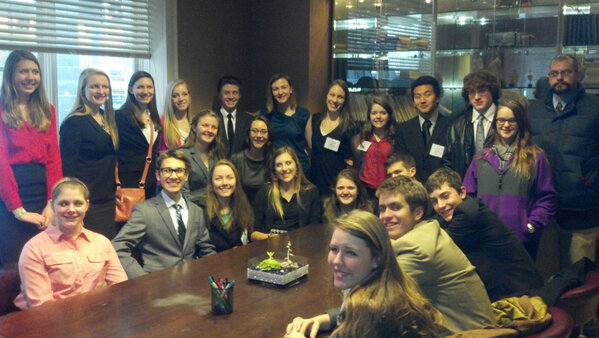
Model UN team at the Chicago Greek Consulate, February 2013

To close, I see a lot of possibilities to bring digital diplomacy into the classroom.  This is a great way to increase students’ awareness of the world around them and to teach them how to use social media as a tool for engagement.  If you have any thoughts on this, I’d love to hear from you.

Thanks for reading.

Educating Future Generations of Atlanticists: A Response to Tobias Bunde

I recently came across an excellent (and important) essay by Tobias Bunde titled, “Will There Be Another Generation of Atlanticists?”  In it, Bunde points out the concern felt by many that the under-40 generation do not seem to appreciate the transatlantic relationship as much as their parents’ or grandparents’ generations.  He also proposes that leaders on both sides of the Atlantic need to do more to point to the future of the transatlantic relationship and not focus as much on the past.  While politicians, economists, and other government officials are surely important for the transatlantic renaissance, we must ask ourselves how we are going to ensure future generations see the benefits and understand the special relationship.  I propose that one of the most important ways to accomplish this is through education.

At one point, Bunde argues that “just telling ourselves again and again about our glorious common history will not suffice to build the ground for a strong transatlantic partnership.”  He is correct in that if we want to move forward with Atlantic community, we cannot continually look to the past and all of its successes.  The past is important, however, if we are going to educate a future generation of Atlanticists.  It is crucial that the under-40, or for that matter the under-20 generation, understand where we came from to better understand where we might possibly go.  In this regard, I am reminded of what John Lewis Gaddis wrote in the preface to his book, The Cold War: A New History.  He said that the book was “meant chiefly… for a new generation of readers for whom the Cold War was never ‘current events.'”  If we want our youth to understand why the transatlantic relationship matters, we must first start with educating them about its past.  For many years, I taught three courses on European history- AP European History (1400-Present); Europe in the Era of Two World Wars; and The Cold War and the Collapse of Communism (in which I assigned Gaddis’ book).  If high schools offered courses like these, we would build a solid foundation for future Atlanticists.

As Bunde mentioned, however, the past alone will not suffice.  We must therefore take it upon ourselves to educate students about the present-day transatlantic community.  (Since I teach in the US, I am going to limit my discussion here to what we can do to teach about Europe and NATO.)  Since NATO is a cornerstone of the transatlantic alliance, teachers should educate their students about the basics and current missions.  The NATO website is fairly easy to navigate and even has resources called LibGuides, “web-based research guides that contain publicly available information.”  I am a bit surprised, however, that I could not find any sort of resources specifically geared towards teachers.

In addition to NATO, students in the US should learn about the EU.  The Delegation of the EU to the US has great resources for teachers.  Personally, I have used the “EU Guide for Americans” and “Europe in 12 Lessons” with my students.  If schools are within thirty miles of Washington, DC, teachers could have one of the diplomats who work at the Delegation visit their classroom.  I was fortunate enough to have Dr. Christian Burgsmüller, Counselor Head of the Energy, Transport and Environment Section, visit my class when he was in Madison for a different event.  Finally, high school students can learn about the EU and Euro by participating in the Euro Challenge.

Teachers should also encourage students to attend seminars and conferences about the transatlantic community and global issues.  Just recently, students and young professionals had the opportunity to attend the Danish Atlantic Youth Seminar.  The goal of the seminar was to “update the post-Cold War generation on current security challenges facing the Alliance and the rest of the world.”  We need seminars like that here in the US.  Additionally, students should participate in Model UN or Model EU (although the latter are usually for post-secondary students).  Being able to delve deeply into one country’s foreign policy and learn how it approaches a variety of issues, can lead to a better understanding of not only other states, but also other international organizations.

Since teachers can play a pivotal role in maintaining and strengthening the transatlantic relationship, institutions and agencies, think tanks, and embassies involved in US-European relations should give teachers an opportunity to learn about them.  Before I read Bunde’s essay, I wrote a piece titled, “Teachers and the Transatlantic Relationship,” for the German Marshall Fund Blog Competition, arguing that teachers (both from the US and Europe) should travel across the Atlantic to learn more about our friends on the “other side of the pond.”  I was extremely fortunate to have been part of a EU study trip to Brussels one summer, but at only five days, it was not long enough for me to create a lesson or unit from my experiences.  I suggest that trips should be three to four weeks in length, with teachers creating a lesson plan at the end of each week based on their experiences.  Let’s say a group of twenty-five teachers goes to Brussels for three weeks.  At the end of that trip, those teachers would have created a combined total of seventy-five lesson plans on various aspects of Europe.  Those teachers will go back and teach many, many students each year about the transatlantic community, thereby educating a future generation of Atlanticists.

I agree with Bunde and others over their concerns regarding the future of the transatlantic relationship.  I also agree with Hillary Clinton when she wrote in her book, Hard Choices, that “For America, our alliance with Europe is worth more than gold.”  We just need to convince our youth why it is so valuable.  Finally, NATO Secretary General Anders Fogh Rasmussen said recently that we need to “deepen our personal and cultural links.”  We can accomplish this by educating our students about the transatlantic relationship and by increasing the amount of teacher exchanges.

Thanks for reading.

Follow up note, July 15, 2014: I neglected to mention that I learned about Tobias Bunde’s essay via a tweet from Joerg Wolf, editor-in-chief of Atlantic Community.

Global Awareness and Civic Engagement with Teenagers

One of the courses I teach is World Studies; a class where my sophomores (15-16 years old) spend a year learning about various regions of the world.  I have many goals for my students, but the two I feel are most important are increasing global awareness and introducing them to the idea of civic engagement.  The past two years I have developed two activities of which I am particularly proud along these lines, and I wanted to share them with you.

Iran
Since the issue of Iran’s nuclear program has been a major news story the past number of years, I decided to have my sophomores write a letter to President Obama with their thoughts on the situation.  To teach the students first about the issue, we watched a Frontline documentary, “Showdown with Iran.”  After that, we read an article from CQ Global Researcher, “Rising Tension Over Iran.”  Most of our time, however, was spent going over the Council on Foreign Relations’ excellent interactive, “Crisis Guide: Iran.”  All of this took us about three weeks to analyze, and once we finished, the students each wrote a letter outlining what they thought was the appropriate course of action for the US to take in regards to Iran;s nuclear energy program.  The only major constraint they had in their opinion was that it had to be based on those they learned about from “Crisis Guide: Iran”- diplomacy, covert action, sanctions, preventive strikes, opposition support, public diplomacy, and do nothing (allow Iran to gain nuclear energy).  For most of my students, this was their first time writing to an elected official, and even though their letters may have reflected that they are not international relations experts, I was very proud of them.

Millennium Development Goals
This year I decided to try a new project with my sophomores- a regional summit at the end of each region we study (Europe, the Americas, Sub-Saharan Africa, MENA, and Asia).  Basically, students worked in pairs representing a different country within the region and had to research that country’s position on our two topics.  For our summits in Europe and the Americas, our two topics were the role of women in development, and protecting the global climate.  For Africa, we will be addressing agriculture development and food security, as well as controlling and eliminating malaria.  All of these topics fall under the realm of the Millennium Development Goals, which we covered for a week at the beginning of the year.

Each of those topics also have an actual UN Resolution, which students used as a starting point for their research.  The first step was to gain a general understanding of the topics.  This entailed analyzing other UN resolutions, visiting NGOs’ websites, and reading up on current events.  Next, they researched their country’s position on those topics. For this part, I had them start with their assigned country’s websites for the ministry of foreign affairs and the permanent mission to the UN.  Finally, they typed up proposed solutions to the problems within those topics based on their country’s policies.

During the summits, students used parliamentary procedure and worked towards creating a resolution (similar to a UN resolution) per issue.  The entire time, they had stay “in character” as a representative of their respective country.  I emphasized that since the goal of each summit was to reach an agreement, then they needed to be prepared to listen to ideas that are different from their own and compromise to create solutions.

It was a great exercise for them to learn how different countries viewed the same problem.  The project gets students to see global issues through multiple perspectives and teaches them about point of view.  For example, during our upcoming Africa summit, they should be able to see the difference in how industrialized countries and less developed countries approach the same issue.

As a culminating assessment for their semester final, students had to pick one of the two topics about women or the global climate and write a letter outlining their personal proposals to either UN Women or the UN Environment Programme.  I thought that this was appropriate for two reasons- 1) they had to show me what they learned about the two topics during our first two regional summits, and 2) it was a lesson in civic engagement.  This was a chance for my sophomores to think about global issues and ways to address some of the problems associated with those issues.  I sent off the letters to the two bodies, so now we wait, hopeful for a response.

If teachers around the world taught their students to become more globally aware, to see local and global issues through different points of view, and encouraged them to get involved in their community (school, local, state, etc.), then perhaps we could break down some stereotypes of other cultures, improve international relations, and begin to make the world a better place.

Thanks for reading.

What Else Can a Social Studies Teacher Do?

A colleague and I were recently talking about our “Plan B’s” if we ever decided to leave teaching and got into a discussion about the types of jobs for which social studies teachers are qualified.  I have thought about leaving teaching for the past two years, and in the process of looking for jobs (and even applying for some of them), I’ve reached some interesting conclusions.

1. Just because I’ve learned a lot and can teach courses on global issues, politics, history, etc., not having “the right degree” has been a stumbling block.  Due to the nature of my interests, most of the jobs I’ve looked into require an advanced degree in something to the effect of international relations, political science, social science, international studies or a related field.  My Master’s Degree is in Curriculum and Instruction with a Professional Development emphasis, which means that of the 36 credits, 12 are in education and 24 are in history.  Since then I’ve taken courses in history and politics at the local university.  The problem is that when HR staff see “Master’s Degree is in Curriculum and Instruction with a Professional Development emphasis,” it does not give them the whole picture.  To try and rectify that, I’ve decided to enroll in the International Politics and Practice Capstone Certificate program at UW-Madison.

2. Along those lines, while I started this blog as a place for me to write down my thoughts on what I read, I’ve since also thought about using it as a sort of e-portfolio for possible employers.  I would like to think that I can write intelligently about global issues, domestic and foreign policy, social media, etc., even though I don’t have a degree specifically in those areas.  I’ve also tried using my Twitter feed for the same purpose.  Perhaps sharing interesting articles and brief thoughts on them will lead somebody to notice that even though I’m “just a teacher,” I still follow developments in the above areas.

3. Teachers need to show possible employers that we are more than babysitters who know a thing or two about some subjects.  Many of us belong to professional organizations so we can read journals and articles about the latest research, developments, and trends.  For example, I belong to the American Historical Association, the Organization of American Historians, and the American Political Science Association.  Teachers can also conduct their own research (my blog for example) and work diligently to become masters of their content.  We work under extreme pressure and in a stressful environment while simultaneously providing guidance to both students and new teachers.  We take pride in our work and achievements, and even more so when it comes to our students.  Educators speak and write clearly and effectively for a variety of audiences; if we do not, it makes the learning process difficult.  We enjoy sharing what we know, but we also know how to ask the right questions so that our students get to a deeper understanding of the content.  Planning is inherent in the job, but teachers also know how to “go with the flow” if they see that it could lead to beneficial outcomes.  Finally, social studies teachers in particular are quite adept at identifying change and continuity over time, comparing and contrasting ideas, and seeing various viewpoints through different lenses.

4. Teaching a variety of courses has led me to be interested in many topics, which can be burdensome when looking for jobs.  Right now I teach US history, US government and politics, US foreign policy, and a world studies course.  In the past, however, I’ve also taught European history courses, world history courses, and even a course on ancient civilizations. (If you click on the “About” page, you can see a list of the courses I’ve taught on my CV).  Teaching at the secondary level requires teachers to become content specialists, which means I’ve learned a considerable amount during the past twelve years.  Obviously, I became a social studies teacher because I really enjoy learning about and discussing history and politics.  The problem is that for me, I can’t get enough, and I always want to know as much as possible.  As such, I’m interested in jobs in a variety of areas- domestic and foreign policy, communication, global issues, and international organizations and NGO’s.  Having a wide variety of interests can be problematic, however, when trying to narrow down a job search.

To close, I leave you with a request (and I’m really putting myself out there with this, but I’ve got to try it).  If you, or someone you know, is looking to hire a professional who is passionate about politics, policy, and social media and wants to use that energy to make a difference in the world, please feel free to contact me.

Thanks for reading.

The Need for Social Studies

On January 10, legislators in the Wisconsin Assembly introduced Assembly Bill 617, calling for “the Department of Instruction to establish model academic standards.”  The bill is timely as the debate over the Common Core State Standards has been heating up in Wisconsin and other states.  I have no problem with people debating whether or not standards should be created by the federal government or the state; in fact, I think it is a discussion worth having every now and then.  My issue with AB 617 lies with the trend of ignoring or overlooking social studies.

In the past few years, there has been an emphasis on STEM (Science, Technology, Engineering, and Math) in education and the workforce.  The WI Department of Instruction has pages devoted to STEM, as do the US Department of Education and the White House.  The Department of Education rationalizes its focus on STEM by arguing that if we don’t push it, the US will not stay a “global leader.”  The White House wants to increase the amount of STEM teachers by 100,000 because they need quality teachers to help prepare students for the “high-paid, highly-rewarding fields of [STEM].”  I understand that as we rely more and more on computers and our technology rapidly improves, we need people to work in those fields.  I also know that American students lag behind their peers in the OECD PISA rankings in math and science. The White House also has a good point about how those jobs can be high-paying.  What I do not understand, however, is the lack of attention given to social studies (or at the university level the humanities and social sciences).

Social studies consists of the following fields: behavioral sciences, economics, geography, history, and political science.  These are the areas in which students learn about themselves and how to relate with others.  In these courses, students begin to understand topics like human rights, globalization, and the roles of international organizations and NGOs.  Teachers like me work to ensure students become globally aware and to appreciate and understand different cultures and belief systems in the world.  Social studies classes are where students learn about civic engagement and what it means to be involved in the public sphere.  Students also see how different types of political and economic systems work (or don’t work).  Understanding where we come from and what has happened before us, can help us avoid the mistakes of the past and make wise choices for the future.  (As a side note, I recommend checking out the American Historical Association’s page, “Why Study History“)  It is through these fields that we can work to eliminate stereotypes, combat prejudice, and fight against extremism.  As a result, teaching social studies and other types of jobs in these fields can also be highly rewarding (not just STEM jobs thank you very much).  Social studies is clearly important to creating a better global society.  So why, when it comes to creating standards or training teachers, is social studies overlooked?

This brings me back to the debate over the Common Core and AB 617.  Go to the Common Core website and read the standards (or at least skim over them).  Did you notice that they only have math and English standards?  History/Social Studies has been lumped into the literacy standards along with science and technical subjects under the English standards.  The only content standards we have for social studies in Wisconsin come from the WI Model Academic Standards, created in 1998.  According to Kristin McDaniel, the social studies consultant at DPI, “the State Superintendent has decided to indefinitely pause social studies standards revision in Wisconsin.”  In AB 617, however, the authors of the bill would like DPI to create new social standards in 2020.  Social studies is given priority over only the arts.  Even though WI has already adopted the Common Core standards for both English and Math, the authors of the bill want new standards for math in 2016 and English in 2017.  Think about how much the world has changed since 1998 (the War on Terror, globalization, BRICS, etc.), and yet, social studies teachers in WI will continue to use outdated standards.  Once again, we see that STEM wins out over social studies.

Here are a few questions I have for the authors of AB 617:

1. Since WI has new (as of 2010) standards for math and English, why not have DPI create new standards for science and social studies first, and then reexamine math and English?

2. What are you (and your Democratic colleagues) going to do to support and promote social studies education and programs in WI?

3. Why are all twenty-two authors/sponsors of the bill Republicans?  What about the bill was unappealing to your Democratic colleagues?

Thanks for reading.