College For All

On May 19, Sen. Bernie Sanders introduced the “College For All Act,” calling for the elimination of “tuition and related fees” at public universities in the United States.  In his speech he gave a number of reasons for his plan, including the fact that 40 million Americans have $1.2 trillion in student loan debt, and many European countries have eliminated their tuition and fees. In essence, he argued that a university education should be a right.

This last concept was introduced back in 1966 in the International Covenant on Economic, Social and Cultural Rights.  Article 13(2)(c) states, “Higher education shall be made equally accessible to all, on the basis of capacity, by every appropriate means, and in particular by the progressive introduction of free education.”  Since then, all but a handful of states have ratified the Covenant– Comoros, Cuba, Palau, Sao Tome and Principe, and the U.S.  In other words, the U.S. is not keeping up with international standards.  We are an exception in the global community.

Since I previously wrote a post comparing the U.S. and Scandinavia, I will not go in to what he said about other countries.  Suffice it to say, he is correct that those countries have eliminated tuition and fees.

Let’s get to the nitty gritty of it all- the cost of eliminating tuition and fees at public universities.  In his plan, the federal government pays for 67% of the total tuition and fees, while the states pick up the remaining 33%.  In order for the federal government to pay for their part, Sanders introduced a tax on Wall Street.  This means that taxpayers have to foot the bill for the state portion.  Being the curious person that I am, I wanted to figure out what that would be here in Wisconsin.

Most of the data I used came from the UW System Fact Book, 2013-2014.  I started by calculating the total number of undergraduates (Freshmen, Sophomores, Juniors, and Seniors only) at each of the UW universities and colleges.  The Fact Book was kind enough to have already split those numbers up into resident and non-residents, although it did not break down non-residents into reciprocity students and non-reciprocity students.  This is important because the cost of tuition for the former is cheaper than for the latter group.  The Fact Book also has the tuition/fees for each institution, again making my life a bit easier.  Since it did not break down students by full time or part time and reciprocity or non-reciprocity, I made everybody full time and the reciprocity students into non-reciprocity students.  This means that my calculations will actually be at the maximum level.  As such, the total amount of undergraduate tuition/fees paid in 2013-2014 for all 26 UW universities and colleges would be $1,513,092,675.  Again, that is higher than actual because of my methodology (making everybody full time and charging all non-residents the out-of-state tuition/fees.)  Under Sen. Sanders’ plan, the federal government’s bill would be $1,013,772,092, leaving $499,320,583 for Wisconsin residents.

To figure out the amount for Wisconsin residents, I used the population numbers from 2013.  Since I could not find numbers for the amount of taxpayers that year, I divided the $499.3 million evenly among those employed in July 2013 (2,887,850).  The resulting amount would be $172.90 per employed person.  For the sake of simplicity, let’s say that rate stays the same for 45 years (putting your employment age from 15-60) and that the employment numbers stay the same.  If you paid $172.90 each year for 45 years, you would pay a total of $7,780.50; the weighted average of tuition/fees in 2013-14 was $7,232.  Over four years that average amounts to $28,928, but you only paid $7,780.50; in other words you pay for one year over your working lifetime and get three years of university education for free.  On top of that, the average debt of borrowers for the UW system as a whole in 2013-2014 was $29,219.  Eliminating tuition and fees just about wipes out that debt, giving students a chance to get on their feet after leaving the university.

While this is not exact, it does give us a ballpark figure.  It clearly shows that eliminating tuition/fees at public universities is actually a better deal than our current system.  As such, I hope that the public will give Sen. Sanders’ plan serious consideration.

Thanks for reading.
Letter in Opposition to AB 194

On May 4, Wisconsin state legislators introduced AB 194, a bill that will require students to take a civics test (based on the U.S. Citizenship Test) in order to receive their high school diploma.  I have read the bill, and I am against it.  What follows is the text of the letter I sent today to the sponsors, my representative, and the chair and co-chair of the Committee on State Affairs and Government Operations.  What do you think- should graduating high school seniors be required to take the civics test?

Thanks for reading.

Dear ,

I am writing to you in opposition to AB 194, which “requires a person to correctly answer at least 60 of 100 questions on a civics test, which is identical to the civics test required to be taken by persons seeking U.S. citizenship, as a prerequisite to obtaining a high school diploma or a high school equivalency diploma.” Requiring a civics test will not make a student more patriotic or more of a citizen, nor will it lead to a sound understanding of our government.

Tests such as the one that would be required by this bill require only rote learning. As a high school social studies teacher, I do not want my students to memorize random facts; I aim to have them perform tasks that require higher order thinking. By requiring purely memorization, this bill goes against sound pedagogical standards.

Instead of encouraging students to learn random facts about the United States, we should be encouraging them to be involved and to vote. We should have lengthy discussions on topics like campaign finance, the role of public opinion, and polarization in politics. We should teach them how to conduct research on policies and candidates so that they can make informed decisions at the polls. We should talk about the abysmal voter turnout in the 2014 midterms and why people did not vote. We should be discussing the problems of our current system and their ideas for addressing them. By requiring students to have only rudimentary knowledge of our political system, this bill will not lead to a more informed and engaged electorate.

I am not saying that students should not know the basics of our government. They should know who represents us in Congress, and they should understand the rights guaranteed in the Bill of Rights. They should not, however, be required to take a test to showcase this knowledge. This test will do nothing to help students become active participants in the political process.

Thank you for your time and consideration.

Sincerely,

Jason Knoll

In Defense of Teachers: A Response to The Economist

I just read a Leader from The Economist titled, “Teacher Recruitment: Those Who Can,” and I have to say that I am quite disappointed.  The piece paints teachers in such a negative manner that I felt compelled to immediately respond.

First, let’s start with the notion that “at least the holidays are long.”  Yes, because we all take ten weeks off in the summer and do nothing but relax and drink fruity drinks with little umbrellas.  Oh, wait, that’s a fantasy.  The reality is that most of my colleagues spend their summers in a variety of ways: working a second job, taking classes (pedagogy or content), and of course, preparing for the next school year.  The breaks we have during the year (the longest being a winter break of 1 1/2 to 2 weeks) are usually spent catching up on grading and reading, as well as preparing for after the break.

Second, you write that “Teaching ought to be a profession for hard-working altruists who want to improve children’s life prospects. But all too often school systems seem designed to attract mediocre timeservers.”  Are you kidding me?  Are. You. Kidding. Me?  The implication that teachers do not work hard is so absurd that it is evidence you have not been around teachers for very long, if at all, except for when you were in school as a student.

My colleagues are some of the hardest-working people I know.  Our contract time is 8 am to 4 pm, but I know of no teacher who actually works only that time.  I wake up at 4:45 am every morning to read the news, looking for items to share with my students that day and to build my content knowledge.  After my 35-minute commute, I arrive to work 1 1/2-2 hours before my contract even starts.  In that time, I read, make copies, grade, look for resources, etc.  Some of my colleagues arrive early as well, while others opt to stay later after school.  When we go home, many of us continue to work there as well.  On top of our “regular” work (although really, there is nothing regular about it) teachers take graduate classes to improve upon their pedagogy or build their content.  Try teaching full time, raising kids, and taking 3-6 credits of graduate classes each semester and tell me that teachers are not hard-working.  Lazy people do not constantly talk about the need for more time, and yet, ask educators what they could use more of, and that will be one of the top answers (my guess is that money would also be a response).

As for being altruistic, do you have any idea how many teachers spend their own money on classroom materials and supplies?  Or how many give up time with their own kids to go to a student’s play/recital/sporting event?  What about the teachers who volunteer their time as club advisors, spending hours of their free time so that they can enrich their students’ lives?  We didn’t go into teaching for the money or prestige, that’s for sure; we became educators because we care, and we want to change lives.

Also, do you really believe that “mediocre timeservers” would choose teaching as a career?  You cannot be mediocre and expect to survive, let alone excel at, teaching.  Why would a slacker want to teach?  We’ve got to deal with expectations from a variety of levels- policymakers, administrators, parents, and students.  In my thirteen years of teaching, I have yet to see somebody who would be a “mediocre timeserver.”  Teachers have to be high-flyers, or else the system will chew them up and spit them out.

Third, you propose that the reason students don’t succeed is because of the teachers, as if we’re the only people in students’ lives.  (“No wonder so many children struggle to learn: no school can be better than those who work in it.”)  You forgot about external factors to students’ academic success.  Broken homes, lack of resources outside of school, working a job, taking care of siblings, etc. all take a toll on students.  Parental pressure to be the very best, increasingly competitive college admissions, teen angst, peer pressure, etc. all take a toll on students.  And yet, for some strange reason, you seem to think that it’s only the teachers in the school who affect how students learn.

Finally, you chose Teach for America as a model to lure high-flyers into the classroom.  I have a number of problems with that particular organization, many of which are summed up nicely in this petition.  Additionally, TFA left a sour taste in my mouth after watching a documentary on them in a grad class.  When asked why they were joining TFA, one of their high-flyers said that they wanted to do something good before they got a real job.  You know, because teaching is not a real job.  Their hearts may be in the right place (helping kids), but TFA only exacerbates the problems with the U.S. education system.

To be sure, lazy, incompetent teachers exist; however, for The Economist to imply that they are the norm is irresponsible and demeaning to all of the great teachers out there who have a positive impact on students every day.  Not every teacher is going to be John Keating, but we try, and we continue working hard in a thankless, demanding, rewarding profession.

Thanks for reading.

What Should US Teachers Know About Transatlantic Relations?

This year at the Wisconsin Council for the Social Studies annual conference, I will be giving a presentation for teachers on why we should teach about transatlantic relations and what to teach about them (themes, resources, etc.).  Most of my presentation is based on the two pieces I wrote on the subject (here and here) and my own teaching experiences.

As I thought about how to make the presentation even more useful for social studies teachers, however, I wondered about giving them suggestions or ideas based on recommendations from European/transatlantic think tanks, organizations, agencies, embassies, etc.  I see this as a great opportunity to exponentially increase the reach that some of these organizations have here in the US.  So, if you work for something or someone that might fit into one of those categories, feel free to leave a comment below or email me.

Thanks for reading.

The Things I Carry

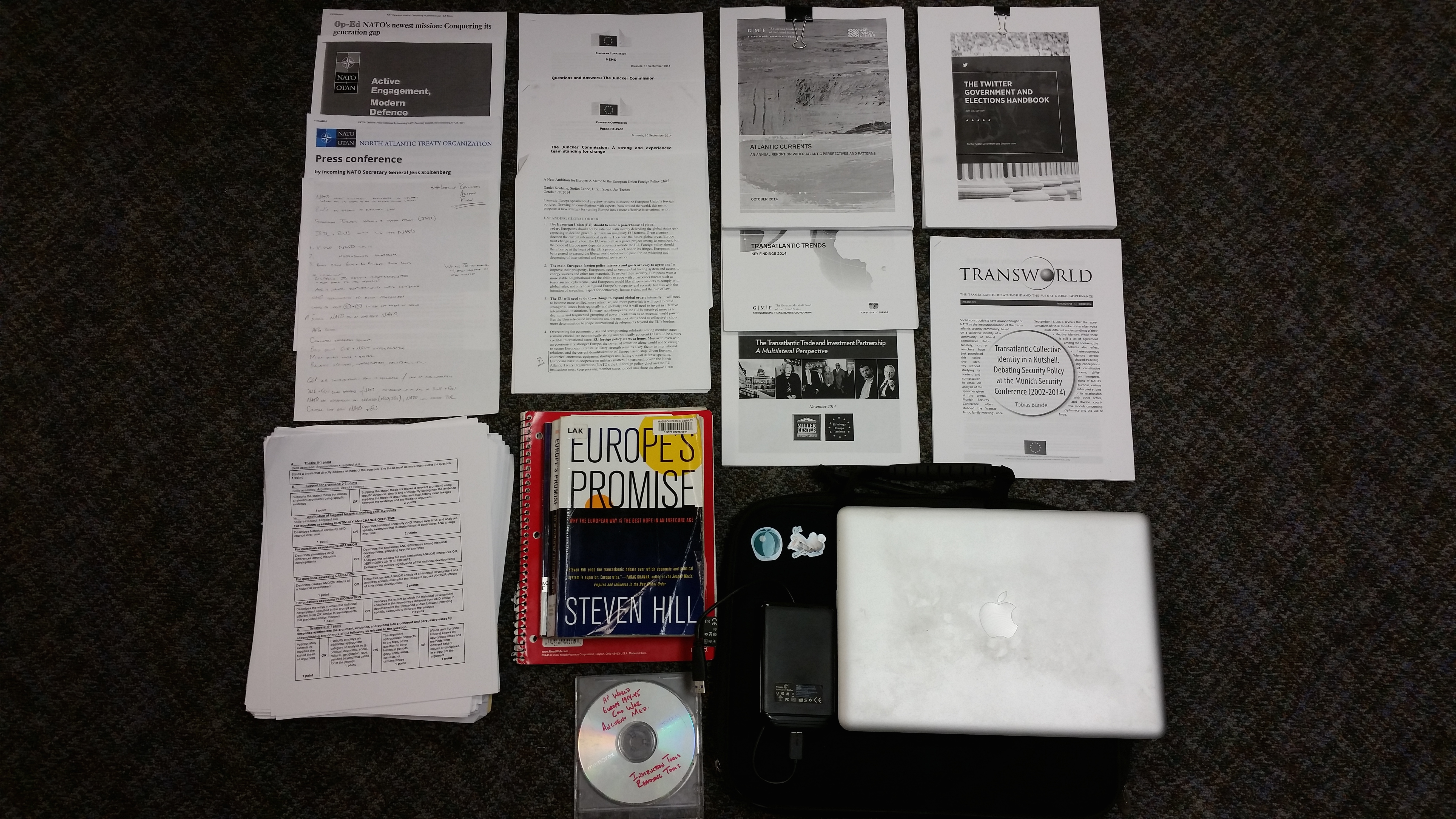
When I left work for home this past Friday, it seemed to me that my backpack was heavier than usual.  As I pulled out the papers and books, I thought of Foreign Policy magazine’s feature titled “The Things They Carried” in which they interview somebody and explore the contents of their backpack/briefcase.  I thought doing something similar would give readers an insight into how my mind works.  This is the result.

The Things I Carry

Starting with the four papers in the upper left corner, I’ve got materials on NATO.  When NATO Secretary General Jens Stoltenberg gave his first press conference, it happened to be during my Government & Politics class.  I thought it would be a great opportunity for my students to watch the conference and discuss it afterwards, so what you see on top is the paper on which I took my notes.  Underneath the transcript of the conference (which I printed off because I wanted to go back over it thinking I might write about it) are NATO’s Strategic Concept and an article by Franklin Miller and Kori Schake titled, “NATO’s newest mission: Conquering its generation gap.”

To the right of my “NATO pile” is my “EU pile,” consisting of “A New Ambition for Europe: A Memo to the European Union Foreign Policy Chief,” and two documents from the European Commission on the new Juncker Commission.  I highly recommend the memo by Daniel Keohane, Stefan Lehne, Ulrich Speck, and Jan Techau, for anybody interested in the EU’s foreign policy.  The other two documents, “The Juncker Commission: A strong and experienced team standing for change,” and “Questions and Answers: The Juncker Commission,” were useful as I watched the changes taking place in Brussels.  For reasons I cannot explain, I find the EU (its history, institutions, foreign policy, etc.) to be extremely fascinating.  As such, I am constantly learning as much as I can about it.

To the right of the “EU pile” is a stack of three reports relating to transatlantic relations- Atlantic Currents: An Annual Report on Wider Perspectives and PatternsTransatlantic Trends: Key Findings, 2014; and The Transatlantic Trade and Investment Partnership: A Multilateral Perspective.  The first two reports come from the German Marshall Fund, a think tank devoted to strengthening transatlantic cooperation.  Out of the numerous think tanks whose websites I regularly visit, I find the GMF to be the most useful and enlightening.  If you are interested in transatlantic relations, you should definitely check them out.  The report on TTIP was just released, and given the importance of trade to the transatlantic relationship, I thought it would be wise to read it.

To the right of that stack is The Twitter Government and Elections Handbook.  Given my interest in how politicians, policymakers, and diplomats use Twitter, I wanted to make sure I had a copy of this.  It’s a fascinating insight into how Twitter thinks politicians and candidates for office should use Twitter.  It starts out with the basics of setting up an account and eventually gets into topics like engaging and mobilizing followers.  I’ve been trying to think of ways to bring this into my Government & Politics class but haven’t quite nailed down what I want to share.

Underneath that is a great article by Tobias Bunde titled, “Transatlantic Collective Identity in a Nutshell: Debating Security Policy at the Munich Security Conference.”  This is the one paper I haven’t gotten to yet; however, knowing Bunde’s work on transatlantic relations (e.g. @FutureNATO and his essay on future generations of Atlanticists), I’m sure it will be worthwhile and useful.

Underneath that, in the lower right corner is my trusty, school-issued MacBook.  All of my lesson plans, tests, and other school work is on this glorious machine.  Next to it is my external drive, which I found out to be extremely valuable after all of the files for one of my classes mysteriously disappeared.  The protective sleeve is usually home to a few stickers courtesy of my children.  In the past it has been home to Bucky Badger, but now Olaf the Snowman graces the cover.  I also have CD’s with materials from courses I no longer teach just in case I want to use a lesson for a current course.

To the left of that is the book Europe’s Promise: Why the European Way is the Best Hope in an Insecure Age, by Steven Hill.  Any time I read a non-fiction book, I have to take notes, hence the notebook underneath.  Call it a bizarre quirk, but it’s important to me to jot down my thoughts and ideas/passages I want to remember.  I chose this book in particular because I recently picked up a copy of Lessons from Europe? What Americans Can Learn from European Public Policies, edited by R. Daniel Kelemen, and I wanted to read the Hill book first.  I think the U.S. has a lot to learn from European policies, but that’s for a future post.

The last pile in the lower left corner consist of four different assignments that need to be graded.  All of them are either essays or short-answers.  I try to do all school work at school (which is why I usually arrive two hours early), but I wanted to get as much done as possible before Thanksgiving break.

I know this may have seemed like a silly exercise, but I rarely share anything personal, and I thought this was a good way of doing so.  Maybe it gave you insight into the way my mind works, or maybe it showed you that I need to clean out my backpack more often.  Either way, one thing should be quite clear- I am passionate about transatlantic relations, and I hope to one day use that passion to maintain and strengthen them.

Thanks for reading.