Views from the Classroom in the Wake of the Election

The past two days have been challenging. Yesterday (November 9) was the most intellectually and emotionally draining day I have had in my fifteen-year career as a high school teacher.  I’ve talked about the presidential and mid-term elections with my students since 2004, but what I saw yesterday was unlike anything I had seen the day after any of the previous elections.

Let me first say that I am a proud liberal.  A social democrat.  A progressive humanitarian.  You get the picture.  So yes, I am disappointed with the election results.  I understand that people have different views on the best ways to govern, and I can respect conservatives like Rep. Paul Ryan who truly believe in small government and the policies that go along with that approach.  I cannot respect, however, a candidate who promotes hate, bigotry, xenophobia, Islamophobia, intolerance, racism, and rape culture.

Given the makeup of the student body at my school, I figured that students (and even staff) would need to process the results of the election on Wednesday.  As such, I offered my room as a safe place for anybody to come and talk about whatever they felt like.  I talked with confused students, concerned students, crying students, and colleagues who felt the same.  I asked students basic questions like “How are you?” “Are you okay?” and “What’s on your mind?” while trying to comfort them and assuage their fears.  Most of all, I wanted them to feel safe.  Here are a just few of their concerns:

  • Worry that their family or friends will be deported
  • Worry that their family or friends will have to wear badges identifying them as Muslims
  • Worry that they will be attacked because they are part of the LGBQT community
  • Worry that their reproductive health rights will be taken away
  • Worry that they will be more susceptible to rape

I cried.

I shook.

I almost threw up.

Of course, I also had to teach the rest of the day.  Thankfully, I had my two classes on government and politics, so discussing the results was built into my schedule.  It was still difficult.  My student teacher and I did our best to keep the conversation fair and balanced, while making sure voices were not stifled and students felt safe.  (I should mention that my student teacher did an amazing job.  He’s going to be a tremendous asset to whichever school he lands a job in.)

When the school day ended we had a faculty meeting to discuss the school climate.  Some of my colleagues cried and shared stories of the hate speech used by our students towards other students.  In our school.  In.  My.  School.

I felt disheartened.

I felt broken.

By the time I got home, I was drained.  I managed to put an abbreviated version of this on Facebook, but it didn’t help.  Even before I went to bed last night I still felt on the verge of tears.

I followed up today with students, checking to see how they were doing and letting them know I was still here for them.  For the most part, however, it was back to business as usual.  Nonetheless, my heart still aches for my students.

I am here for you.

Thanks for reading.
 

Where are the Teachers in WI Government?

We know that teachers in Wisconsin can be quite political when needed (remember how many marched, rallied, and spoke to protest Act 10?)  We also know that educating our children is one of the most important services our government provides.  So why is it then, that very few teachers are in the Wisconsin state legislature?

It seems to me that if the state government really wanted to improve public education, the best people to give input are public school teachers.  To be sure, many current legislators support public education (my own representative, Rep. Sondy Pope, is one of them), and WEAC does great work advocating for teachers, but the legislature is missing the crucial voices of teachers themselves.  Of the current ninety-nine representatives in the WI State Assembly, only one has ever taught in public schools, and in the Senate that number is zero (based on the information in their biographies).

So, where are the teachers in WI state government?  We are the ones who see the effects of cuts to education funding every day, and we are some of the most dedicated public servants- working long hours, caring for their students as if they were our own, and even spending our own money on classroom materials.  Who better to speak up for public education in Wisconsin than teachers?  Is it that teachers don’t run for office?  Or perhaps they have but were defeated?  If we really want to fix public education, we need to stop talking about it waiting in line for the copier or in the lunchroom; instead, we need teachers to run for office and win.

Thanks for reading.

Hunger and Food Insecurity: An Introduction

Not only is food essential for life, it is also a human right.  Clause 25(1) of the Universal Declaration of Human Rights says “Everyone has the right to a standard of living adequate for the health and well-being of himself and of his family, including food, …” and the UN General Assembly has gone so far as to pass a resolution titled, “The Right to Food.”  Despite this recognition, however, people around the world still go hungry and contend with food insecurity, as well as the effects of it.

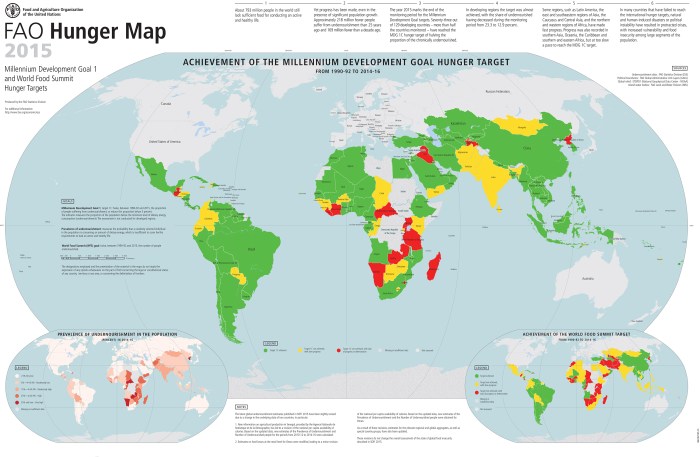
With the expiration of the Millennium Development Goals (MDG’s) in 2015, the UN established the Sustainable Development Goals (SDG’s)- seventeen goals with a total of 169 targets designed to make the world a better place.  Goal 2 “aims to end hunger and all forms of malnutrition by 2030. It also commits to universal access to safe, nutritious and sufficient food at all times of the year.”  While the situation around the world has improved since the MDG’s were established, people still suffer from chronic hunger.  The Food and Agricultural Organization (FAO) states, “About 793 million people in the world still lack sufcient (sic) food for conducting an active and healthy life.”

HM-2015-ENG-026-notrim

The United States
Looking at the above map, we see the United States is not in as bad a situation compared to the rest of the global community.  In fact, the proportion of undernourished is less than 5% of the population.  It’s important to recognize, however, that millions of U.S. households are food insecure.  According to the USDA’s Household Food Security in the United States in 2015:

  • 12.7 percent of U.S. households (15.8 million households) were food insecure
  • 5.0 percent of U.S. households (6.3 million households) had very low food security (italics in original)
  • Children were food insecure at times during the year in 7.8 percent of U.S. households with children (3.0 million households)

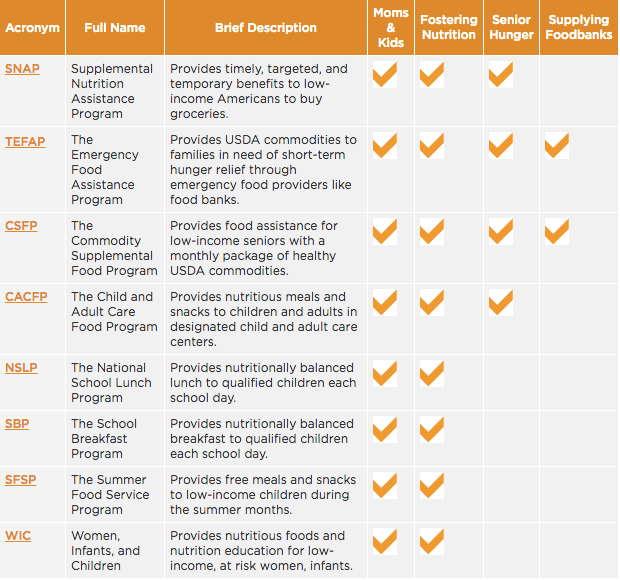
While those numbers are down from 2014, they should still be cause for alarm.  There is no good reason that people living in the world’s largest economy go hungry.  To be sure, the government has a number of programs in place to help ease the effects of hunger and food insecurity, but the fact that we have so many people living that way is problematic.

screen-shot-2016-10-11-at-2-33-58-pm
Federal Food Assistance Programs. Source: Feeding America, http://www.feedingamerica.org/take-action/advocate/federal-hunger-relief-programs/

Wisconsin
The situation in Wisconsin is also disheartening.  In 2014, 687,370 people were food insecure, and in Dane County alone, that number was 58,480 (Feeding America).  Looking at the Kids Count Data Center, we see that 52,554 individuals participated in SNAP that year.

What Can Be Done?
Despite the federal programs available, it is clear that more needs to be done to ensure “universal access to safe, nutritious and sufficient food at all times of the year.”  The first question we should ask is why federal and state lawmakers continue to allow the problem of hunger and food insecurity to perpetuate.  The fact that these problems still exist means one of two things- either politicians are choosing to ignore them, or they are choosing to give other policy areas priority.  We, as the electorate, and as human beings, should be concerned that our elected officials are not protecting basic human rights.  Hold them accountable- email them, call their offices, etc.

Also at a policy-level, we should ensure USDA child nutrition programs receive more funding.  If children live in food insecure households, their only meals might come from the schools they attend.  As such, we must make sure they are fed while they are in school.  To address the issue of feeding children during the summer (when school is not in session), the USDA has the Summer Food Service Program.  For that to work, however, more people need to be willing to sponsor or manage sites.

If those ideas don’t appeal to you, here are some simple actions you can take (from “The Lazy Person’s Guide to Saving the World“):

  • Freeze fresh produce and leftovers if you don’t have the chance to eat them before they go bad. You can also do this with take-away or delivered food, if you know you will not feel like eating it the next day. You will save food and money.
  • Shop Smart—plan meals, use shopping lists and avoid impulse buys. Don’t succumb to marketing tricks that lead you to buy more food than you need, particularly for perishable items. Though these may be less expensive per ounce, they can be more expensive overall if much of that food is discarded.
  • Buy Funny Fruit—many fruits and vegetables are thrown out because their size, shape, or color are not “right”. Buying these perfectly good funny fruit, at the farmer’s market or elsewhere, utilizes food that might otherwise go to waste.

Conclusion
Food is a basic human right, but for some reason, our lawmakers continue to allow hunger and food insecurity to plague our society.  Since they are failing to provide for their constituents, we need to step up and help.  No person, especially a child, should go without food.

Thanks for reading.

Additional Resources
Sustainable Development Goal 2

Food and Agricultural Organization

World Food Programme

Supplemental Nutrition Assistance Program (SNAP)

Community Action Coalition for South Central Wisconsin

Ensuring Food Security in Wisconsin Households

City of Madison Food Waste Reduction Taskforce

Ideas for a Study Trip to London and Brussels

I love the idea of study trips for students.  They are great opportunities to make the curriculum more real, and they can make lifetime memories.  Our school offers a number of trips through the foreign languages department (I actually get to chaperone the German trip), but I’ve always wanted to offer a study trip for one of my courses.  As such, I’m thinking of offering a trip to London and Brussels to study British politics and the EU.

Why those topics?
One of the courses I teach is AP Comparative Government & Politics.  It’s probably my favorite course to teach because we focus on six countries (China, Iran, Mexico, Nigeria, Russia, and the UK), and the EU is part of the curriculum.

On top of that, I’ve been to Brussels before (once as part of a trip sponsored by the Delegation of the EU to the US, and another time for a seminar hosted by the German Marshall Fund).  Plus, in the past five years I’ve been on Twitter, I’ve been fortunate to have made a number of connections with people who work in EU institutions or write extensively about the EU.

London
Here are my learning objectives for London, followed by ideas to accomplish them:

  1. Learn about the parliamentary system and the functions of the House of Commons and the House of Lords- Tour Parliament (talk w/ MP’s?)
  2. Learn about the major political parties (Conservatives, Labour, LibDems, UKIP, SNP, etc.)- Meet with members of political parties (tour HQ?)
  3. Learn about the election process- Meet with somebody from the Electoral Commission
  4. Learn about the role of the media- Tour BBC and The Guardian, and maybe talk with journalists
  5. Learn about unions- Meet with representatives of the Trade Unions Congress
  6. Learn about the NHS- Meet with representatives
  7. Learn about UK foreign policy- Tour the Foreign Office and talk about US-UK relations and Brexit

Brussels
Here are my learning objectives for Brussels, followed by ideas to accomplish them:

  1. Learn about the EU institutions- Tour and talk with representatives of the European Parliament, European Council, Council of the EU, European Commission
  2. Learn about the role of the media- Tour PoliticoEurope and viEUws and talk with journalists
  3. Learn about transatlantic relations- Meet with representatives from the US Mission to the EU and the US Mission to NATO

Funding
As it stands, the students will pay for the entire trip, but I wonder if there are any grants for such opportunities, especially ones that promote transatlantic relations.

What I Would Like from Readers
If you have ideas about how to make those objectives happen- people to talk to, places to see, funding, etc.- please leave a comment below.  Also, if you happen to work in one of the places I mentioned, or you know somebody who does, please leave me a comment with the best way to contact you.  Finally, one of the factors I have to consider is that some places want a certain of ratio of students to chaperones, so if you’re aware of anything like that, please let me know as well.

Ideally, I would love for this trip to occur every other summer; so, if I can make this first one a success, I should be able to continue offering it.

**UPDATE: As I’ve been doing research and talking with all of the people who have made suggestions/offers on Twitter, I’m thinking it might be easier for me to make the first trip a Brussels-only trip.  It will be easier for me to plan and get my feet wet in the world of study trips.  I will, however, still definitely welcome suggestions for London for future trips.

Thanks for reading.


A Case for Proportional Representation in the US

For a few years now, I’ve thought that the US needs to move to proportional representation (PR) for our electoral system.  Now that we’re done with the conventions for both major parties here, it is more apparent than ever that we need to move to it.

What is Proportional Representation?
Basically, PR is an electoral system in which parties on a ballot are given the same percentage (or as close to it as possible) of seats in the legislature as they received in the election.  Usually, parties have to receive a certain percentage of votes (a threshold) in order to receive seats.  For example, if your party of choice received 25% of the votes in the election, it would have 25% of the seats in the legislature.  It should be noted, however, that PR is used in parliamentary systems, which means the US would have to move to one as well.

Why Is Now a Good Time for the US to Adopt a PR System?
PR is much more democratic than our current First Past the Post system.  As it stands, all a candidate needs to receive to win is a majority of the vote.  So, if they receive 51%, they win and go on into office.  That also means that 49% of the population now feel they are not being represented.

A PR system would also make voting more pleasant in situations like we now find ourselves.  We’ve got two candidates for president that are quite disliked.  Take a look at this article, for example, over at fivethrityeight, “Americans’ Distaste for both Trump and Clinton is Record-Breaking.”  In it, Harry Enten, points out that “Clinton and Trump are both more strongly disliked than any nominee at this point in the past 10 presidential cycles.”

In addition to the unpopularity of the candidates, the two major parties are split over their nominees.  As we saw at the recent Democratic convention, Bernie Sanders’ supporters are unhappy with the process and the results.  On the Republican side, Ted Cruz spoke at the convention about voting one’s conscience (i.e. don’t vote for Trump if you don’t like him).

So, if you don’t like either candidate, for whom do you vote?  Progressives are being told to suck it up and vote for Clinton because if they don’t, Trump will win, and that could lead to a dictatorship.  Conservatives are being told to suck it up and vote for Trump because if they don’t, Clinton will win, and that will mean at least four more years of Obama-esque policies.  They’re also being told a vote for the Greens and Jill Stein, or the Libertarians and Gary Johnson, is just a wasted vote and could lead to Clinton/Trump winning.  What do you do then if you truly believe in the platforms of Stein or Johnson?

What Might a PR System Look Like in the US?
Based on the current situation, I think we would have at least six big parties.  These are just generic names, so you can name them whatever you please- Greens, Social Democrats (Bernie Sanders’ supporters), Moderate Democrats (Hillary Clinton supporters), Moderate Republicans (non-Trump supporters), Nationalists (Trump supporters), and Libertarians.

This system would truly allow people to vote their conscience and feel represented in government.  It might also help avoid the gridlock and government shutdowns we currently experience.

For more information on the PR system I recommend the two following websites: FairVote and the Electoral Reform Society.

What do you think- is it time for the US to change our electoral system?

Thanks for reading.