Hindsight in Politics and Policy

The GOP today sent out this tweet concerning Hillary Clinton and the US “reset” with Russia–

GOP Tweet on March 19, 2014

This seems like another attempt by the GOP to discredit the work that Clinton did as Secretary of State, especially in the context of her possible presidential bid for the 2016 election.  It got me thinking, however, about time limits, if any, that political parties, experts, and even the public can place on criticizing policy when using hindsight.

Russia
During a speech at the 45th Munich Conference on Security Policy in February 2009, Vice President Joe Biden told attendees that America’s relations under the new Obama administration were “rooted in a strong bipartisanship.”  During the speech, Biden urged members of the audience to “press the reset button” and work with Russia.  Among the examples that Biden gave as areas for cooperation were NATO missions, the war in Afghanistan, the conflict in Georgia, and nuclear weapons.

Throughout the twentieth century, the relationship between the United States and Russia was characterized mostly by competition and conflict.  The cold war nearly brought the two superpowers to blows, but with the collapse of the Soviet Union, the threat of a third world war had subsided.  As the United States filled the role of the world’s lone superpower in the 1990s, Russia embarked on a rebuilding process. The abundance of resources such as oil and natural gas led to resurgence in Russia’s influence.  As Russia exerted its influence in the region, the relationship with the United States under the second President Bush began to falter.  After the conflict in Georgia during the summer of 2008, relations between Washington and Moscow “sunk to a new low.”  With this in mind, the newly elected President Obama worked to improve relations with the Eurasian power.

Fast forward five years, and given recent events in Ukraine, and in Crimea in particular, it is no wonder that the GOP is questioning the White House’s decision to hit the “reset” button in this tweet; however, we should ask ourselves why the GOP didn’t attack VP Biden in the tweet.  If attacking White House policy were the goal of the tweet, then it would seem reasonable to call out VP Biden for the policy since he was the one who made the initial speech at Munich calling for the “reset.”  (Maybe they don’t have a picture of Biden and Russian Foreign Minister Lavrov holding a “reset” button.)  This leads me to conclude that the policy portion of the tweet is merely a smokescreen for the political part- discrediting Clinton as we get closer to 2016.

Hindsight
At what point can we stop using hindsight to critique policies?  Yes, it appears now that the “reset” was not successful.  At the time, however, in 2009, it seemed like sound policy.  If we’re going to use what we know now to critique policy-making decisions and their outcomes, couldn’t we do the same to the GOP?  Since the US aided the Mujahideen during the Soviet war in Afghanistan, and elements of the Mujahideen evolved into the Taliban, can we blame the GOP for supplying terrorists?  What about US support for Iraq during the Iran-Iraq War?  Within two years of the end of that war the US was going to war with Saddam Hussein, the Iraqi leader we had just supported.  Again, can we say to the GOP that they made poor decisions, or do we conclude that they were the right decisions at the time and that we cannot predict the future?

Thanks for reading.
Recent US-EU Relations

In his recent State of the Union Address, President Obama stated that “Our alliance with Europe remains the strongest the world has ever known.”  While I agree that EU-US relations are strong, I do not get the sense that the US is doing enough to assure our European allies that that is indeed the case.

In the wake of the NSA scandal, our European allies have spoken of trust issues in relations with the US.  During a recent discussion about the future of the Polish-American relationship, Bartosz Węglarczyk, a Polish journalist, voiced concerns that not only was the US turning away from Poland, but that Poland was doing the same to the US.  He believed that possible causes of the deteriorating relations were a lack of US public diplomacy in Poland and the NSA affair.  Former German Chancellor Gerhard Schroeder, discussing US surveillance of current Chancellor Angela Merkel and recent discoveries that his phone had also been tapped while he was in office, stated that “The US has no respect for a loyal partner and the sovereignty of our country.”

The most recent event, however, that might give the EU cause for concern over the transatlantic relationship, were recent remarks by the Assistant Secretary of State for European and Eurasian Affairs, Victoria Nuland.   In a phone conversation with Geoffrey Pyatt, the US Ambassador to Ukraine, Nuland, apparently frustrated with the way the EU was handling the ordeal with Ukraine, is heard saying the US might be able to get the UN involved which would “have the UN help glue [an agreement], and you know, fuck the EU.”  Those are not exactly the words our European allies want to hear from an American diplomat.

European Response

When asked about the remarks during a press conference, Pia Ahrenkilde Hansen, Spokesperson for the European Commission, said, “We don’t comment on the content of alleged intercepted communications…Intercepted private conversations is not part of the toolbox that we use in our efforts to assist Ukraine.”  She went on to say that the EU will “remain fully engaged with all our international partners.”  The European External Action Service had no news about the remarks on their website.  Not exactly strong responses to Nuland’s powerful words.

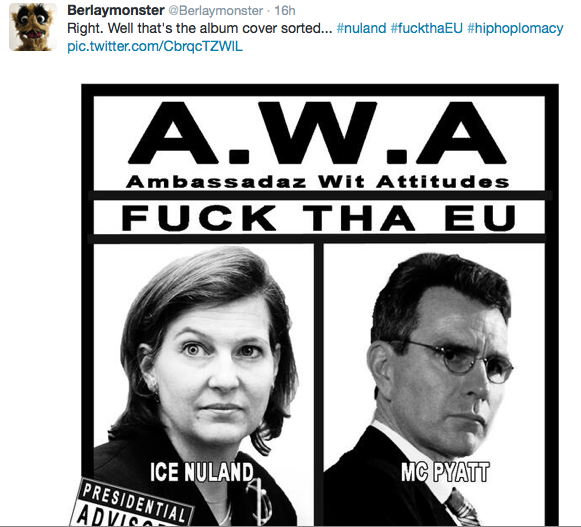
On Twitter, Gareth Harding, Managing Editor of Clear Europe and a lecturer at the Missouri School of Journalism tweeted his concerns that the EU did not give a proper response, saying that if German Chancellor Merkel could call the remarks “absolutely unacceptable”, then the EU should as well.  In a later tweet, Harding referenced the Commission’s “No comment,” using the hashtag, #growsome.  Eva Peña brought up larger issues behind the lack of response, tweeting about the EU’s lack of influence and its impotence when it comes to relations with the US.  The EU Delegation to the US did not tweet at all about the remarks.  Berlaymonster attempted to infuse humor into the situation with a tweet referencing an old American rap group, NWA–

Screen Shot 2014-02-07 at 8.25.59 PM

I must say that I am a bit puzzled by the “No comment” from the Commission.  I expected something along the lines of “Obviously, we are disappointed, but we will move forward…”  What does this tell us about how the EU views its role in the transatlantic relationship?  Are Harding’s and Peña’s tweets characteristic of broader European public’s frustration over the EU’s relationship with the US?  If so, how is the US going to resolve the problem?  While it is clear that official diplomatic relations need to be smoothed over, this also necessitates an increase in American public diplomacy in Europe.

US Response

An NPR story quoted Jay Carney, the White House Press Secretary, as saying, “The video was first noted and tweeted out by the Russian government; I think it says something about Russia’s role,” perhaps alluding to the idea that Russia was trying to interfere with EU-US discussions over Ukraine.  Asst. Sec. Nuland has since apologized to EU officials; however,  during a February 7 press conference, instead of addressing her gaffe, she also pointed to the role of Russia, saying they used “pretty impressive tradecraft” in recording the conversation between Amb. Pyatt and herself.  US State Department Spokesperson Jen Psaki added in a different press conference that Nuland’s remarks “[don’t] reflect how she feels about our relationship with the EU. It’s also important to note that she’s been in close touch with EU officials since then – not about this, but about work we’re doing together on Ukraine.”  In the wake of the NSA scandal, is the US government in any position to call out Russia for tapping phone conversations?

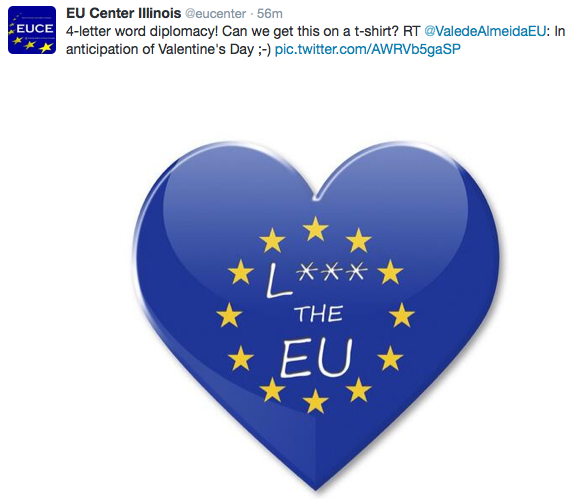
On Twitter, the only response by the Office of Press and Policy Outreach in the Bureau of European and Eurasian Affairs was a tweet about Nuland’s press conference. The US Mission to the EU had no response on their website and tweeted only about wetlands as part of their #GreenFriday series.  Similar to Berlaymonster, the EU Center at the University of Illinois at Urbana-Champaign put a humorous spin on the whole ordeal–

Screen Shot 2014-02-07 at 9.31.48 PM

Questions

Should private conversations matter in diplomatic relations?  Was Sec. Nuland blowing off steam to a colleague, (as I’m sure many of us have at some point in time about one issue or another), or are the remarks indicative of general US sentiments towards the EU?  Will this affect TTIP negotiations?  How will the US rebuild trust with its European allies?

Thanks for reading.

Update: I have since realized that while the EU Delegation to the US did not explicitly tweet about the remarks, Ambassador João Vale de Almeida is responsible for the tweet with the graphic of the heart that says, “L*** the EU.”

The State of the Union, Twitter, and Me

If you go back to one of my first blog pieces, “How I Use Twitter,” you’ll see that I began actively using Twitter to participate in a White House Twitterchat for the 2012 State of the Union.  Over 2,000 Tweets later, I’m still going strong and have enjoyed all of the connections I’ve made along the way.  I’d like to think that I’ve shared some interesting articles and reports in the past two years.  On top of that, I’ve tried to use Twitter to engage with my elected representatives and other political figures.  I’ve even developed a unit on politics and social media for the government class I teach.  Needless to say, I was really excited then when I opened up my email from the White House telling me I’ve been invited to the 2014 State of the Union Social.

The Social is an opportunity for White House “social media followers to join in-person events, engage with administration officials, and share their experience with their friends.”  It’s going to be a quick trip- I fly out Monday and come back Wednesday- but it should be very rewarding.  I’m looking forward to live-tweeting the speech from the White House and participating in the post-speech panels with administration officials.  I think this will be a great way to show my students that social media can be an effective tool and that it can lead to some really awesome opportunities.  Of course, I will also try to see the sights, especially the White House and Capitol, and hopefully the EU Delegation to the US.

If I’m being completely honest, I have to admit that I am a bit nervous about live-tweeting from the White House.  I feel like my Tweets during the SOTU will be under closer scrutiny than they usually are and that people will be judging me more so than they might already.  I’m honored to have been chosen to attend this prestigious event, and I don’t want the White House to feel like they made a poor choice in having me there.  All of my hard work to use Twitter as a professional tool has led to this moment, and I don’t want to waste this opportunity.

I look forward to writing about my trip and tweeting, and I hope that it will lead to some great discussions and even more opportunities to put my passion for history, politics, and social media to use.

Thanks for reading.

Global Awareness and Civic Engagement with Teenagers

One of the courses I teach is World Studies; a class where my sophomores (15-16 years old) spend a year learning about various regions of the world.  I have many goals for my students, but the two I feel are most important are increasing global awareness and introducing them to the idea of civic engagement.  The past two years I have developed two activities of which I am particularly proud along these lines, and I wanted to share them with you.

Iran
Since the issue of Iran’s nuclear program has been a major news story the past number of years, I decided to have my sophomores write a letter to President Obama with their thoughts on the situation.  To teach the students first about the issue, we watched a Frontline documentary, “Showdown with Iran.”  After that, we read an article from CQ Global Researcher, “Rising Tension Over Iran.”  Most of our time, however, was spent going over the Council on Foreign Relations’ excellent interactive, “Crisis Guide: Iran.”  All of this took us about three weeks to analyze, and once we finished, the students each wrote a letter outlining what they thought was the appropriate course of action for the US to take in regards to Iran;s nuclear energy program.  The only major constraint they had in their opinion was that it had to be based on those they learned about from “Crisis Guide: Iran”- diplomacy, covert action, sanctions, preventive strikes, opposition support, public diplomacy, and do nothing (allow Iran to gain nuclear energy).  For most of my students, this was their first time writing to an elected official, and even though their letters may have reflected that they are not international relations experts, I was very proud of them.

Millennium Development Goals
This year I decided to try a new project with my sophomores- a regional summit at the end of each region we study (Europe, the Americas, Sub-Saharan Africa, MENA, and Asia).  Basically, students worked in pairs representing a different country within the region and had to research that country’s position on our two topics.  For our summits in Europe and the Americas, our two topics were the role of women in development, and protecting the global climate.  For Africa, we will be addressing agriculture development and food security, as well as controlling and eliminating malaria.  All of these topics fall under the realm of the Millennium Development Goals, which we covered for a week at the beginning of the year.

Each of those topics also have an actual UN Resolution, which students used as a starting point for their research.  The first step was to gain a general understanding of the topics.  This entailed analyzing other UN resolutions, visiting NGOs’ websites, and reading up on current events.  Next, they researched their country’s position on those topics. For this part, I had them start with their assigned country’s websites for the ministry of foreign affairs and the permanent mission to the UN.  Finally, they typed up proposed solutions to the problems within those topics based on their country’s policies.

During the summits, students used parliamentary procedure and worked towards creating a resolution (similar to a UN resolution) per issue.  The entire time, they had stay “in character” as a representative of their respective country.  I emphasized that since the goal of each summit was to reach an agreement, then they needed to be prepared to listen to ideas that are different from their own and compromise to create solutions.

It was a great exercise for them to learn how different countries viewed the same problem.  The project gets students to see global issues through multiple perspectives and teaches them about point of view.  For example, during our upcoming Africa summit, they should be able to see the difference in how industrialized countries and less developed countries approach the same issue.

As a culminating assessment for their semester final, students had to pick one of the two topics about women or the global climate and write a letter outlining their personal proposals to either UN Women or the UN Environment Programme.  I thought that this was appropriate for two reasons- 1) they had to show me what they learned about the two topics during our first two regional summits, and 2) it was a lesson in civic engagement.  This was a chance for my sophomores to think about global issues and ways to address some of the problems associated with those issues.  I sent off the letters to the two bodies, so now we wait, hopeful for a response.

If teachers around the world taught their students to become more globally aware, to see local and global issues through different points of view, and encouraged them to get involved in their community (school, local, state, etc.), then perhaps we could break down some stereotypes of other cultures, improve international relations, and begin to make the world a better place.

Thanks for reading.

What Else Can a Social Studies Teacher Do?

A colleague and I were recently talking about our “Plan B’s” if we ever decided to leave teaching and got into a discussion about the types of jobs for which social studies teachers are qualified.  I have thought about leaving teaching for the past two years, and in the process of looking for jobs (and even applying for some of them), I’ve reached some interesting conclusions.

1. Just because I’ve learned a lot and can teach courses on global issues, politics, history, etc., not having “the right degree” has been a stumbling block.  Due to the nature of my interests, most of the jobs I’ve looked into require an advanced degree in something to the effect of international relations, political science, social science, international studies or a related field.  My Master’s Degree is in Curriculum and Instruction with a Professional Development emphasis, which means that of the 36 credits, 12 are in education and 24 are in history.  Since then I’ve taken courses in history and politics at the local university.  The problem is that when HR staff see “Master’s Degree is in Curriculum and Instruction with a Professional Development emphasis,” it does not give them the whole picture.  To try and rectify that, I’ve decided to enroll in the International Politics and Practice Capstone Certificate program at UW-Madison.

2. Along those lines, while I started this blog as a place for me to write down my thoughts on what I read, I’ve since also thought about using it as a sort of e-portfolio for possible employers.  I would like to think that I can write intelligently about global issues, domestic and foreign policy, social media, etc., even though I don’t have a degree specifically in those areas.  I’ve also tried using my Twitter feed for the same purpose.  Perhaps sharing interesting articles and brief thoughts on them will lead somebody to notice that even though I’m “just a teacher,” I still follow developments in the above areas.

3. Teachers need to show possible employers that we are more than babysitters who know a thing or two about some subjects.  Many of us belong to professional organizations so we can read journals and articles about the latest research, developments, and trends.  For example, I belong to the American Historical Association, the Organization of American Historians, and the American Political Science Association.  Teachers can also conduct their own research (my blog for example) and work diligently to become masters of their content.  We work under extreme pressure and in a stressful environment while simultaneously providing guidance to both students and new teachers.  We take pride in our work and achievements, and even more so when it comes to our students.  Educators speak and write clearly and effectively for a variety of audiences; if we do not, it makes the learning process difficult.  We enjoy sharing what we know, but we also know how to ask the right questions so that our students get to a deeper understanding of the content.  Planning is inherent in the job, but teachers also know how to “go with the flow” if they see that it could lead to beneficial outcomes.  Finally, social studies teachers in particular are quite adept at identifying change and continuity over time, comparing and contrasting ideas, and seeing various viewpoints through different lenses.

4. Teaching a variety of courses has led me to be interested in many topics, which can be burdensome when looking for jobs.  Right now I teach US history, US government and politics, US foreign policy, and a world studies course.  In the past, however, I’ve also taught European history courses, world history courses, and even a course on ancient civilizations. (If you click on the “About” page, you can see a list of the courses I’ve taught on my CV).  Teaching at the secondary level requires teachers to become content specialists, which means I’ve learned a considerable amount during the past twelve years.  Obviously, I became a social studies teacher because I really enjoy learning about and discussing history and politics.  The problem is that for me, I can’t get enough, and I always want to know as much as possible.  As such, I’m interested in jobs in a variety of areas- domestic and foreign policy, communication, global issues, and international organizations and NGO’s.  Having a wide variety of interests can be problematic, however, when trying to narrow down a job search.

To close, I leave you with a request (and I’m really putting myself out there with this, but I’ve got to try it).  If you, or someone you know, is looking to hire a professional who is passionate about politics, policy, and social media and wants to use that energy to make a difference in the world, please feel free to contact me.

Thanks for reading.